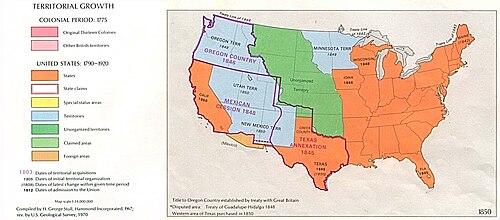
The Mexican–American War, also known in the United States as the Mexican War, and in Mexico as the United States intervention in Mexico, was an invasion of Mexico by the United States Army from 1846 to 1848. It followed the 1845 American annexation of Texas, which Mexico still considered its territory because Mexico refused to recognize the Treaties of Velasco, signed by President Antonio López de Santa Anna after he was captured by the Texian Army during the 1836 Texas Revolution. The Republic of Texas was de facto an independent country, but most of its Anglo-American citizens who had moved from the United States to Texas after 1822 wanted to be annexed by the United States.
Liberal Valentín Gómez Farías, who served as Santa Anna's vice president and implemented a liberal reform in 1833, was an important political player in the era of the Mexican–American War.
U.S. Army full dress and campaign uniforms, 1835–1851.
Sarah A. Bowman "The Great Western", depicted as the Heroine of Fort Brown. At her death, she was buried with full military honors.
The United States Army (USA) is the land service branch of the United States Armed Forces. It is one of the eight U.S. uniformed services, and is designated as the Army of the United States in the U.S. Constitution. The Army is the oldest branch of the U.S. military and the most senior in order of precedence. It has its roots in the Continental Army, which was formed on 14 June 1775 to fight against the British for independence during the American Revolutionary War (1775–1783). After the Revolutionary War, the Congress of the Confederation created the United States Army on 3 June 1784 to replace the disbanded Continental Army. The United States Army considers itself a continuation of the Continental Army, and thus considers its institutional inception to be the origin of that armed force in 1775.
The storming of Redoubt No. 10 in the Siege of Yorktown during the American Revolutionary War prompted Great Britain's government to begin negotiations, resulting in the Treaty of Paris and Great Britain's recognition of the United States as an independent state.
General Andrew Jackson standing on the parapet of his makeshift defenses as his troops repulse attacking Highlanders during the defense of New Orleans, the final major and most one-sided battle of the War of 1812, mainly fought by militia and volunteers.
The Battle of Gettysburg, the turning point of the American Civil War