Michael Allan Cook FBA is a British historian and scholar of Islamic history. Cook is the general editor of The New Cambridge History of Islam.
Professor Cook during the Holberg Symposium, 2014
Cook receiving the Farabi International Award in 2008, Iranian president Mahmoud Ahmadinejad presiding
The history of Islam concerns the political, social, economic, military, and cultural developments of the Islamic civilization. Most historians believe that Islam originated with Muhammad's mission in Mecca and Medina at the start of the 7th century CE, although Muslims regard this time as a return to the original faith passed down by the Abrahamic prophets, such as Adam, Noah, Abraham, Moses, David, Solomon, and Jesus, with the submission (Islām) to the will of God.
Coin of the Rāshidūn Caliphate (632–675 CE). Pseudo-Byzantine type with depictions of the Byzantine emperor Constans II holding the cross-tipped staff and globus cruciger.
Close-up of one leave showing chapter division and verse-end markings written in Hijazi script from the Birmingham Quran manuscript, dated between c. 568 and 645, held by the University of Birmingham.
1314 manuscript illustration by Rashid ad-Din depicting the Negus of medieval Abyssinia declining a Meccan delegation's request to surrender the early Muslims.
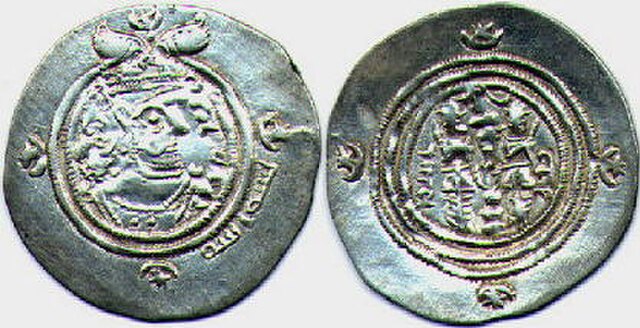
The rāshidūn caliphs used symbols of the Sasanian Empire (crescent-star, fire temple, depictions of the last Sasanian emperor Khosrow II) by adding the Arabic expression bismillāh on their coins, instead of designing new ones.