Microfossil
Videos
A microfossil is a fossil that is generally between one micrometre and one millimetre in size, the visual study of which requires the use of light or electron microscopy. A fossil which can be studied
An enigmatic carbonaceous microfossil, Cochleatina canilovica, from the Late Ediacaran


Microfossils from a deep sea sediment core

A Late Silurian chitinozoan from the Burgsvik beds showing its flask shape

Acritarch from the Weng'an biota c. 570–609 mya
Micropaleontology
Videos
Micropaleontology is the branch of paleontology that studies microfossils, or fossils that require the use of a microscope to see the organism, its morphology and its characteristic details.
Marine microfossils: (diatom, ostracod, radiolarian, sponge spicule, radiolarian, planktonic foraminiferan (two), coccolith)


Diatomaceous earth is a soft, siliceous, sedimentary rock made up of microfossils in the form of the frustules (shells) of single cell diatoms. This sample consists of a mixture of centric (radially symmetric) and pennate (bilaterally symmetric) diatoms. This image of diatomaceous earth particles in water is at a scale of 6.236 pixels/μm, the entire image covers a region of approximately 1.13 by 0.69 mm.

Fusulinid (Triticites) from the Plattsmouth Chert, Red Oak, Iowa (Permian).
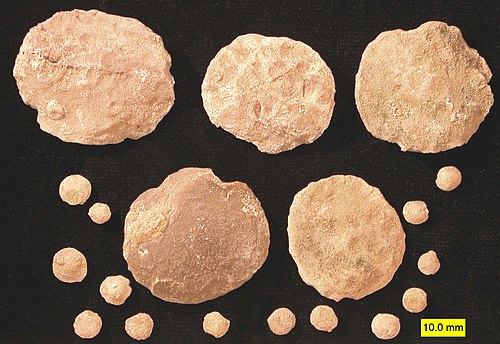
Fossil nummulitid foraminiferans showing microspheric and megalospheric individuals; Eocene of the United Arab Emirates; scale in mm.