Mie scattering
Videos
In electromagnetism, the Mie solution to Maxwell's equations describes the scattering of an electromagnetic plane wave by a homogeneous sphere. The solution takes the form of an infinite series of sph
The change of sky colour at sunset (red nearest the sun, blue furthest away) is caused by Rayleigh scattering by atmospheric gas particles, which are much smaller than the wavelengths of visible light. The grey/white colour of the clouds is caused by Mie scattering by water droplets, which are of a comparable size to the wavelengths of visible light.

Rayleigh scattering
Videos
Rayleigh scattering is the scattering or deflection of light, or other electromagnetic radiation, by particles with a size much smaller than the wavelength of the radiation. For light frequencies well
Mie scattering
…form factor). The notable features of these results are the Mie resonances, sizes that scatter particularly strongly or weakly. This is in contrast to Rayleigh scattering for small particles and Rayleigh–Gans–Debye scattering (after Lord Rayleigh, Richard Gans and Peter Debye) for large particles. The existence of…

Rayleigh scattering causes the blue color of the sky at large angles to the direction of solar rays and yellow or orange colors for light from the direction of the Sun.

Due to Rayleigh scattering, red and orange colors are more visible during sunset because the blue and violet light has been scattered out of the direct path. This can yield dramatically colored skies and monochromatic rainbows.
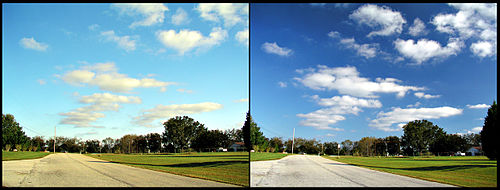
Scattered blue light is polarized. The picture on the right is shot through a polarizing filter: the polarizer transmits light that is linearly polarized in a specific direction.

Rayleigh scattering in opalescent glass: it appears blue from the side, but orange light shines through.