Military
Videos
A military, also known collectively as armed forces, is a heavily armed, highly organized force primarily intended for warfare. Militaries are typically authorized and maintained by a sovereign state,

NATO military ceremony in Pabradė, Lithuania, November 2014
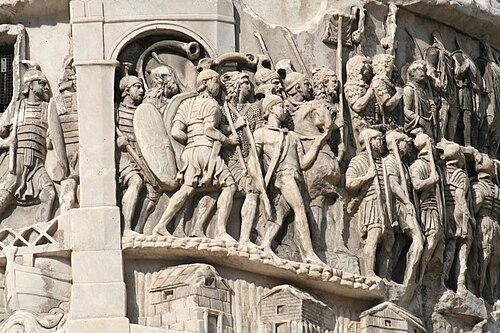
Relief scene of Roman legionaries marching, from the Column of Marcus Aurelius, Rome, Italy, 2nd century AD

Depiction of ancient Egyptian military formation

Finnish and American soldiers training together in arctic conditions in Lapland, Finland, January 6–16, 2015
Civil control of the military is a doctrine in military and political science that places ultimate responsibility for a country's military strategic decision-making in the hands of the civil authority

Secretary of the Air Force Verne Orr with Chairman of The Joint Chiefs of Staff General David C. Jones and Air Force Chief of Staff General Lew Allen and Air Force Vice Chief of Staff General Robert C. Mathis at a ceremony in Bolling Air Force Base in 1982. In this capacity the Secretary of the Air Force served as the civilian head of the Department of the Air Force which includes the U.S. Air Force and Space Force. As the civilian head, the Secretary of the Air Force also oversaw most of the Department of the Air Force operational and day-to-day activities. The service chiefs which include The Air Force Chief of Staff and Chief of Space Operations also reported directly to the Secretary of the Air Force, but not the

Admiral John B. Nathman (far right) and Admiral William J. Fallon salute during honors arrival of Secretary of the Navy Gordon R. England at a change of command ceremony in 2005. A subordinate of the civilian Secretary of Defense, the Secretary of the Navy is the civilian Head of the Department of the Navy, which includes the U.S. Navy and the Marine Corps.

Vietnamese Minister of Defence Phan Văn Giang alongside U.S. Secretary of Defense Pete Hegseth. While the Vietnamese position is always a military officer holding the army general rank, his American counterpart is nominally civilian, with Hegseth himself having retired from formal armed forces' services years before becoming the SecWar. Despite different design and identity, they seemed externally-equivalent and both holding the second-highest in their military's

Secretary of Defense Donald H. Rumsfeld with Chairman of the Joint Chiefs of Staff General George S. Brown. While the Chairman of the Joint Chiefs of Staff acts as the highest-ranking and most senior military officer in the United States Armed Forces, the civilian Secretary of Defense acts as the highest-ranking and most senior position within the Department of Defense.