During the Mongol invasions and conquests, which began under Genghis Khan in 1206–1207, the Mongol army conquered most of continental Asia, including parts of West Asia, and parts of Eastern Europe, w

14th-century depiction of Mongol warriors in lamellar armour, on Mongolian ponies and using unique cavalry techniques, pursuing their enemy.

Mongol cavalry archery from Rashid-al-Din Hamadani's Universal History using the Mongol bow.

Mongol soldiers using bow, in Jami al-Tawarikh by Rashid al-Din, BnF. MS. Supplément Persan 1113. 1430–1434 AD.

Triple-Bow Siege Crossbow
Siege of Baghdad
Videos
The Siege of Baghdad, also known as the Sack of Baghdad, took place in early 1258. A large army commanded by Hulegu, a prince of the Mongol Empire, attacked the historic capital of the Abbasid Calipha
Military of the Mongol Empire
…willingly or otherwise. Therefore, as they expanded into other areas and conquered other people, their troop numbers increased. Exemplifying this is the Battle of Baghdad, during which many diverse people fought under Mongol lordship. Despite this integration, the Mongols were never able to gain long-term loyalty from…

Depiction of Hulegu's army besieging the city, c. 1430

The Talisman Gate, built in 1220–1221 by al-Nasir, protected the eastern walls of Baghdad at the time of the siege.

Depiction of the siege in a 14th-century manuscript of Rashid al-Din's Jami al-tawarikh; the soldiers on the pontoons block the dawatdar from escaping down the Tigris.
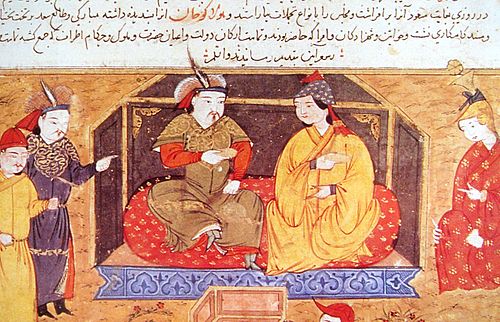
Depiction of Hulegu Khan and his wife Doquz Khatun, from a 15th-century manuscript of the Jami al-tawarikh by Rashid al-Din