Miller–Urey experiment
Videos
The Miller–Urey experiment, or Miller experiment, was an experiment in chemical synthesis carried out in 1952 that simulated the conditions thought at the time to be present in the atmosphere of the e
Portrait photograph of Alexander Oparin


Stanley Miller in 1999, posed with an apparatus like that used in the original experiment

The surface of Titan as viewed from the Huygens lander. Tholins, complex particles formed by UV irradiation on the N2 and CH4 atmosphere, are likely the source of the reddish haze.

Conceptual figure from Wogan et al. (2023) depicting three stages phases of atmospheric chemistry after a large asteroid impact on the Hadean Earth. In phase 1, the impactor vaporizes the ocean, and H2 is generated after iron delivered by the impactor reacts with hot steam. In phase 2, H2 reacts with CO2 to produce CH4 while the atmosphere cools for thousands of years and steam condenses to an ocean. Phase 3 represents the Miller–Urey atmosphere that persists for millions of years, where N
Abiogenesis
Videos
Abiogenesis or the origin of life is the natural process by which life arises from non-living matter, such as simple organic compounds. The prevailing scientific hypothesis is that the transition from
Miller–Urey experiment
…prebiotic Earth. It is seen as one of the first successful experiments demonstrating the synthesis of organic compounds from inorganic constituents in an origin of life scenario. The experiment used methane (CH4), ammonia (NH3), hydrogen (H2), in ratio 2:2:1, and water (H2O). Applying an electric arc (simulating…

If banded iron formation rocks of Archaean age (like these from Australia) are fossilized stromatolites, they would be among the earliest life-forms.
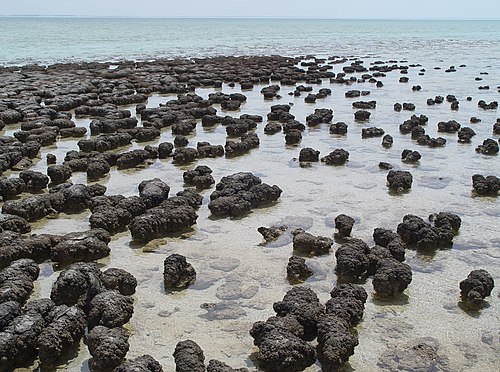
Modern stromatolites in Shark Bay, created by photosynthetic cyanobacteria

The Cat's Paw Nebula is inside the Milky Way Galaxy, in the constellation Scorpius. Green areas show regions where radiation from hot stars collided with large molecules and small dust grains called "polycyclic aromatic hydrocarbons" (PAHs), causing them to fluoresce. Spitzer Space Telescope, 2018.

The earliest known life forms may be putative fossilized microorganisms, found in white smoker hydrothermal vent precipitates. They may have lived as early as 4.28 Gya (billion years ago), relatively soon after the formation of the oceans 4.41 Gya, not long after the formation of the Earth 4.54 Gya.