Mine Planter Service
Videos
The U.S. Army Mine Planter Service (AMPS) was an outgrowth of civilian crewed Army mine planter ships dating back to 1904. It was established on July 22, 1918 by War Department Bulletin 43 and placed the Mine Planter Service under the U.S. Army Coast Artillery Corps. Its purview was to install and maintain the underwater minefields that were part of the principal armament of U.S. coastal fortifications, including those at the approaches to the Panama Canal and the defenses of Manila Bay in the Philippines.

USAMP MP-7 Major General Wallace F. Randolph, Army M 1 Mine Planter Hull No. 480. Records (#742), Special Collections Department, J. Y. Joyner Library, East Carolina University, Greenville, North Carolina, USA.
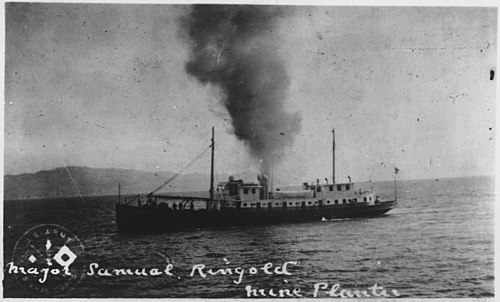
USAMP Major Samuel Ringgold, built in 1904. (National Archives and Records Administration)
Seacoast defense was a major concern for the United States from its independence until World War II. Before airplanes, many of America's enemies could only reach it from the sea, making coastal forts an economical alternative to standing armies or a large navy. After the 1940s, it was recognized that fixed fortifications were obsolete and ineffective against aircraft and missiles. However, in prior eras foreign fleets were a realistic threat, and substantial fortifications were built at key locations, especially protecting major harbors.

The outer works of Fort McHenry in Baltimore harbor, although built in the 1860s, are broadly similar to early First and Second System forts built prior to the War of 1812, with low earthworks, although mounting much larger cannon and reinforced with masonry. The cannon are 8-inch converted rifles (lined down from 10-inch Rodman guns) and a 15-inch Rodman gun, typical of the post-Civil War era.

The Statue of Liberty is built on top of Fort Wood of the Second System

50-pounder Model 1811 Columbiad (7.25 inch or 184 mm bore) and center-pivot mounting designed by George Bomford as an experimental coastal defense gun. This gun was built in 1811 as a component of the Second System. Photographed in Clear Lake, Wisconsin.

Fort Point - San Francisco - example of a mid-1800s Third System fort