Minor sabotage
Videos
A minor sabotage during World War II in Nazi-occupied Poland (1939–45) was any underground resistance operation that involved a disruptive but relatively minor and non-violent form of defiance, such as the painting of graffiti, the manufacture of fake documents, the disrupting of German propaganda campaigns, and the like. Minor-sabotage operations often involved elements of humor.


Kotwica graffito on Warsaw's Aviator Monument

Warsaw's Nicolaus Copernicus monument was the target of a celebrated minor-sabotage operation.
The occupation of Poland by Nazi Germany and the Soviet Union during World War II (1939–1945) began with the Invasion of Poland in September 1939, and it was formally concluded with the defeat of Germany by the Allies in May 1945. Throughout the entire course of the occupation, the territory of Poland was divided between Nazi Germany and the Soviet Union (USSR), both of which intended to eradicate Poland's culture and subjugate its people. In the summer-autumn of 1941, the lands which were annexed by the Soviets were overrun by Germany in the course of the initially successful German attack on the USSR. After a few years of fighting, the Red Army drove the German forces out of the USSR and crossed into Poland from the rest of Central and Eastern Europe.

Beginning of Lebensraum, the German expulsion of Poles from western Poland, 1939

Operation Tannenberg, October 1939, mass murder of Polish townsmen in western Poland

German and Soviet soldiers stroll around Sambir after the German-Soviet invasion of Poland.
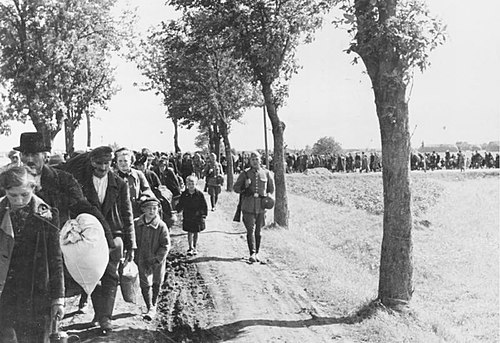
Expulsion of Poles from western Poland, with Poles led to the trains under German army escort, 1939.