Mir
Videos
Mir was a space station operated in low Earth orbit from 1986 to 2001, first by the Soviet Union and later by the Russian Federation. Mir was the first modular space station and was assembled in orbit
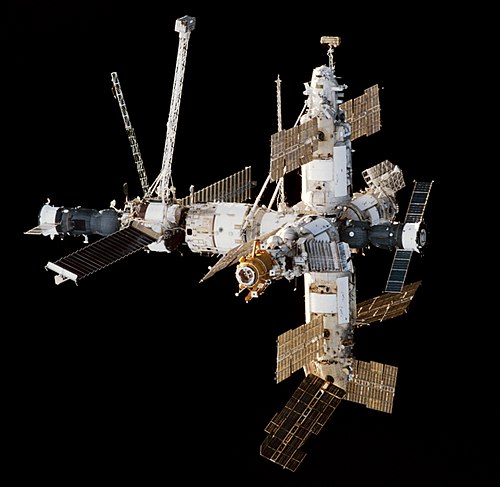
Mir seen from Space Shuttle Endeavour during STS-89 (28 January 1998)

The Travers radar antenna, Sofora girder, VDU thruster block, SPK unit and a Strela crane, alongside Kvant-2 and Priroda

The four solar arrays on Spektr

Reinhold Ewald (right) and Vasily Tsibliyev in the core module during Ewald's visit to Mir
International Space Station
Videos
The International Space Station is a space station in low Earth orbit. It is the product of the International Space Station program and is operated by five partner space agencies: NASA, Roscosmos, ESA
Mir
…space station and was assembled in orbit from 1986 to 1996. At the time it was the largest artificial satellite in orbit, only being succeeded by the International Space Station (ISS) after Mir's deorbiting in 2001. The station served as a microgravity research laboratory in which crews conducted experiments in biology, human…

Obverse view in October 2018

A painting of Apollo–Soyuz, a first milestone in international spaceflight
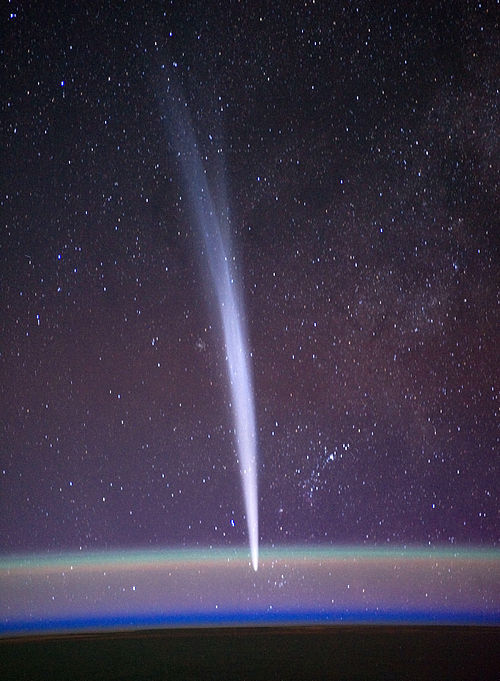
Comet Lovejoy photographed during Expedition 30

Michael Foale conducts an inspection of the Microgravity Science Glovebox during Expedition 8.