Mise en abyme
Videos
In Western art history, mise en abyme is the technique of placing a copy of an image within itself, often in a way that suggests an infinitely recurring sequence. In film theory and literary theory, i
Las Meninas by Velázquez, used by Gide to demonstrate the technique of mise en abyme


Southwestern entrance mosaic of Hagia Sophia, Constantinople, depicting both Hagia Sophia itself and Constantinople, both offered to Jesus and the Virgin Mary
Las Meninas
Videos
Las Meninas is a 1656 oil painting in the Museo del Prado in Madrid, by Diego Velázquez, the leading artist in the court of King Philip IV of Spain and Portugal, and of the Spanish Golden Age. It has
Mise en abyme
…to describe self-reflexive embeddings in various art forms and to describe what he sought in his work. As examples, Gide cites both paintings such as Las Meninas by Diego Velázquez and literary forms such as William Shakespeare's use of the "play within a play" device in Hamlet, where a theatrical company presents…

The Infanta Margaret Theresa (1651–1673), in mourning dress for her father in 1666, by del Mazo. The background figures include her young brother Charles II and the dwarf Maria Bárbola, also in Las Meninas. She left Spain for her marriage in Vienna the same year.

Detail showing Philip IV's daughter, the Infanta Margaret Theresa. Most of her left cheek was repainted after being damaged in the fire of 1734.
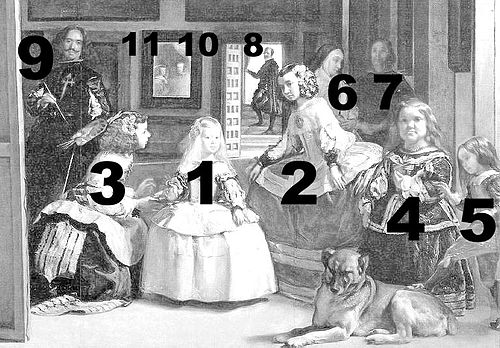
Key to the people represented: see text