Molybdenum
Videos
Molybdenum is a chemical element; it has symbol Mo and atomic number 42. The name is derived from Ancient Greek μόλυβδος mólybdos, meaning lead, since its ores were sometimes confused with those of le
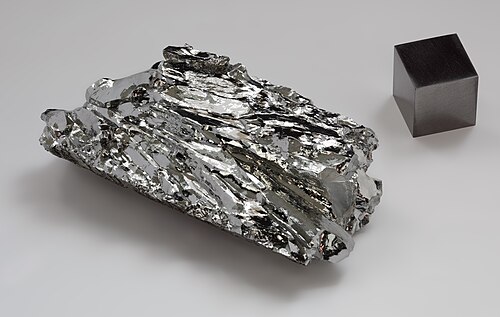
Molybdenum crystaline fragment and 1cm 3 cube

Molybdenite on quartz

A plate of molybdenum copper alloy
Technetium
Videos
Technetium is a chemical element; it has symbol Tc and atomic number 43. It is the lightest element whose isotopes are all radioactive. Technetium is one of only two radioactive elements both preceded
Molybdenum
…undergoes double beta decay into ruthenium-100 with half-life 7.07×10¹⁸ years. All the synthetic isotopes of molybdenum decay into isotopes of niobium, technetium, or zirconium. The most stable of them is 93Mo, with a half-life of 4,839 years to electron capture, giving stable niobium. The most common isotopic…

Technetium-99 electroplated onto a strip of gold foil

Periodisches System der Elemente (Periodic system of the elements) (1904–1945, now at the Gdańsk University of Technology): lack of elements: polonium 84Po (though discovered as early as in 1898 by Maria Sklodowska-Curie), astatine 85At (1940, in Berkeley), francium 87Fr (1939, in France), neptunium 93Np (1940, in Berkeley) and other actinides and lanthanides. Uses old symbols for: argon 18Ar (here: A), technetium 43Tc (Ma, masurium), xenon 54Xe (X),

Chloro-containing coordination complexes of technetium (99Tc) in various oxidation states: Tc(III), Tc(IV), Tc(V), and Tc(VI) represented.

The first technetium-99m generator, unshielded, 1958. A Tc-99m pertechnetate solution is being eluted from Mo-99 molybdate bound to a chromatographic substrate