Moons of Saturn
Videos
Saturn has 293 moons with confirmed orbits as of June 2026, the most of any planet in the Solar System. Saturn's moons are diverse in size, ranging from tiny moonlets to Titan, which is larger than th

An annotated picture of Saturn's many moons captured by the Cassini spacecraft. Shown in the image are Dione, Enceladus, Epimetheus, Prometheus, Mimas, Rhea, Janus, Tethys and Titan.

Saturn (overexposed) and the moons Iapetus, Titan, Dione, Hyperion, and Rhea viewed through a 12.5-inch telescope

Five moons in a Cassini image: Rhea bisected in the far-right foreground, Mimas behind it, bright Enceladus above and beyond the rings, Pandora eclipsed by the F Ring, and Janus off to the left

Artist conception of Saturn, its rings and major icy moons—from Mimas to Rhea
Enceladus
Videos
Enceladus is the sixth-largest moon of Saturn and the 18th largest in the Solar System. It is about 500 kilometres in diameter, about a tenth of that of Saturn's largest moon, Titan. It is covered by
Moons of Saturn
…these moons possess particularly notable features: Titan has a nitrogen-rich atmosphere and a landscape featuring river networks and hydrocarbon lakes; Enceladus emits jets of ice from its south-polar region and is covered in a deep layer of snow; and Iapetus has contrasting black and white hemispheres as well…

Enceladus imaged by the Cassini orbiter, October 2015

William Herschel, discoverer of Enceladus

Enceladus is Saturn's second smallest moon. It is about one-tenth the diameter then Titan, Saturn's largest moon.
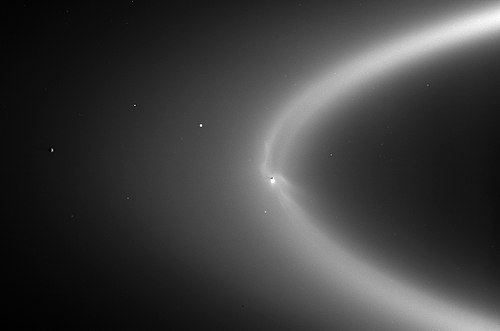
Enceladus orbiting within Saturn's E ring