Mulberry harbour
Videos
Mulberry harbours were two temporary portable harbours developed by the British Admiralty and War Office during the Second World War to facilitate the rapid offloading of cargo onto beaches during the Allied invasion of Normandy in June 1944. Designed in 1942 and then built in under a year in great secrecy, within hours of the Allies successfully creating beachheads following D-Day, sections of the two prefabricated harbours and old ships, to be sunk to create breakwaters, were being towed across the English Channel from southern England and placed in position off Omaha Beach and Gold Beach.


Phoenix caissons under construction in Southampton in 1944

Aerial view of Mulberry harbour "B" at Arromanches-les-Bains in Normandy (October 27, 1944)

The remains of the harbour off Arromanches in 1990
Normandy landings
Videos
The Normandy landings were the landing operations and associated airborne operations on Tuesday, 6 June 1944 of the Allied invasion of Normandy in Operation Overlord during World War II. Codenamed Operation Neptune and often referred to as D-Day, it is the largest seaborne invasion in history. The operation began the liberation of France, and the rest of Western Europe, and laid the foundations of the Allied victory on the Western Front.

Taxis to Hell – and Back – Into the Jaws of Death, an iconic image of men of the 16th Infantry Regiment, US 1st Infantry Division wading ashore from their landing craft on Omaha Beach on the morning of 6 June 1944

Meeting of the Supreme Headquarters Allied Expeditionary Force (SHAEF), 1 February 1944. Front row: Air Chief Marshal Sir Arthur Tedder; General Dwight D. Eisenhower; General Sir Bernard Montgomery. Back row: Lieutenant General Omar Bradley; Admiral Sir Bertram Ramsay; Air Chief Marshal Sir Trafford Leigh-Mallory; Lieutenant General Walter Bedell Smith.

Shoulder patches were designed for units of the fictitious First United States Army Group under George Patton.
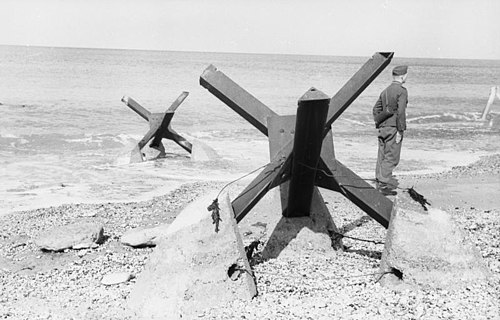
Czech hedgehogs deployed on the Atlantic Wall near Calais