Music of Turkey
Videos
The roots of traditional music in Turkey span across centuries to a time when the Seljuk Turks migrated to Anatolia and Persia in the 11th century and contains elements of both Turkic and pre-Turkic i

Bursa State Symphony Orchestra in 2009

Ottoman orchestra of Suleiman the Magnificent

Female musical players. Ottoman miniature painting, 18th century.

Surname-i Vebbi (fol. 172a), showing military band.
Ottoman music
Videos
Ottoman music or Turkish classical music is the tradition of classical music originating in the Ottoman Empire. Developed in the palace, major Ottoman cities, and Sufi lodges, it traditionally feature
Music of Turkey
…vibrant local music scenes which, in turn, support a number of regional musical styles. Until the 1960s, Turkish music scene was dominated by two genres, Turkish classical music and Turkish folk music with some staple figures like Aşık Veysel, Emel Sayın, Zeki Müren, Şevval Sam, Bülent Ersoy. The 70s came with Anatolian rock…

A transcription and analysis of Ottoman music using Byzantine notation.
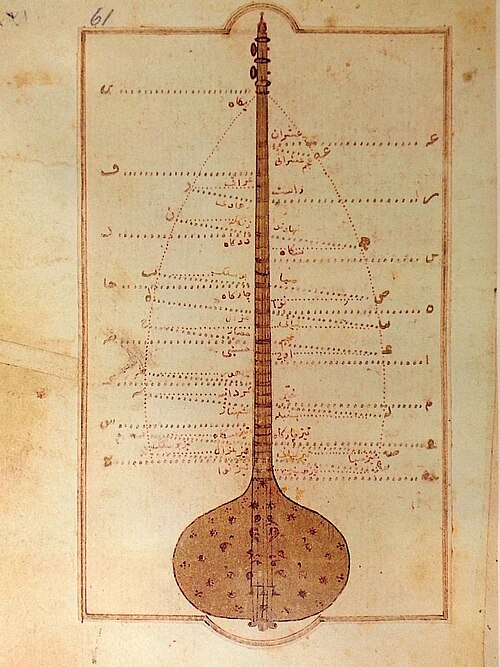
Description and illustration of a tanbûr from Kitâb-ı ‘İlmü’l Mûsîkî ala Vechi’l-Hurûfat, written by Dimitrie Cantemir.

A peşrev (prelude) transcribed into staff notation by Polish musician Wojciech Bobowski. The use of abjad notation was more common in the Ottoman Empire until the 20th century.