Muslims conquered Transoxiana between 651 and 751, shortly after their conquest of Persia enabled them to enter Central Asia. Relatively small-scale incursions had taken place under the Rashidun Calip
Mural depicting Arabs besieging the city of Samarkand, which was ultimately captured in 722 – Palace of Divashtich (706–722), Panjakent


Horseman mural from Mount Mugh, circa 700 AD. Hermitage Museum

Ayaz Kala, a fortress of Khwarizm (6th to 8th century AD)

Male bust from Tokharistan, 7th/8th century AD
Sogdia
Videos
Sogdia or Sogdiana was an ancient Iranian civilisation located between the Amu Darya and the Syr Darya rivers, in what is now Uzbekistan, Turkmenistan, Tajikistan, Kazakhstan, and Kyrgyzstan. Sogdiana
Muslim conquest of Transoxiana
…into four regions: Tokharistan on the upper Oxus valley, surrounded by the Hissar Mountains to the north and the Hindu Kush to the east and south; Sogdia to the east of the middle course of the Oxus, and around the Zarafshan river; Khwarizm or Chorasmia, on the lower Oxus and the river's confluence into…
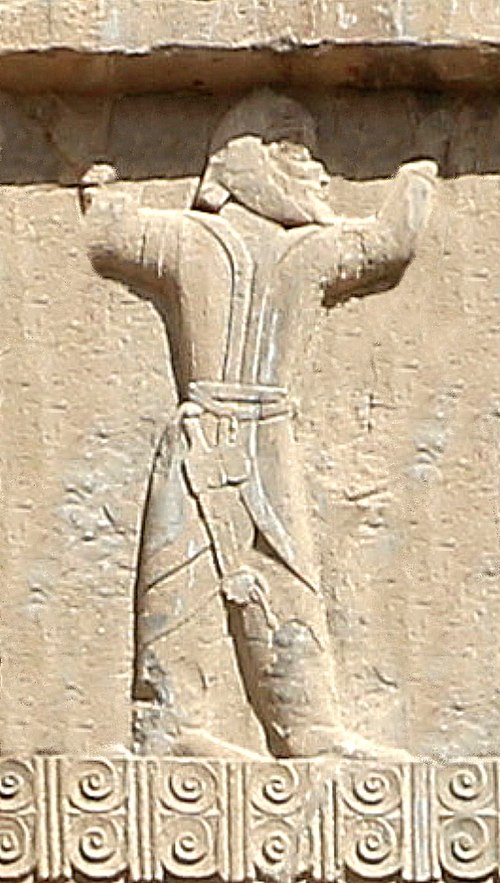
Sogdian soldier circa 338 BCE, tomb of Artaxerxes III.

Sogdians on an Achaemenid Persian relief from the Apadana of Persepolis, offering tributary gifts to the Persian king Darius I, 5th century BC

Head of a Saka warrior, as a defeated enemy of the Yuezhi, from Khalchayan, northern Bactria, 1st century BCE.

A Yuezhi (left) fighting a Sogdian behind a shield (right), Noin-Ula carpet, 1st century BC/AD.