N1 (rocket)
Videos
The N1 was a super heavy-lift launch vehicle of the Soviet space program intended for crewed travel to the Moon and beyond. All four launch attempts between 1969 and 1972 failed. Studied and designed
Mockup at the Baikonur Cosmodrome in late 1967

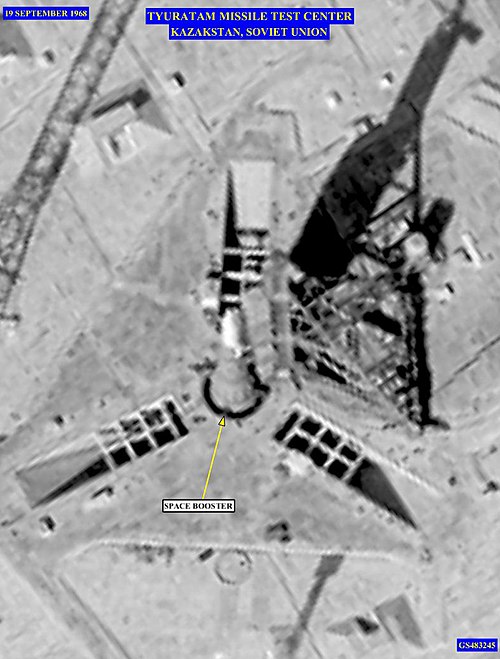
N1 imaged by US KH-8 Gambit reconnaissance satellite, 19 September 1968
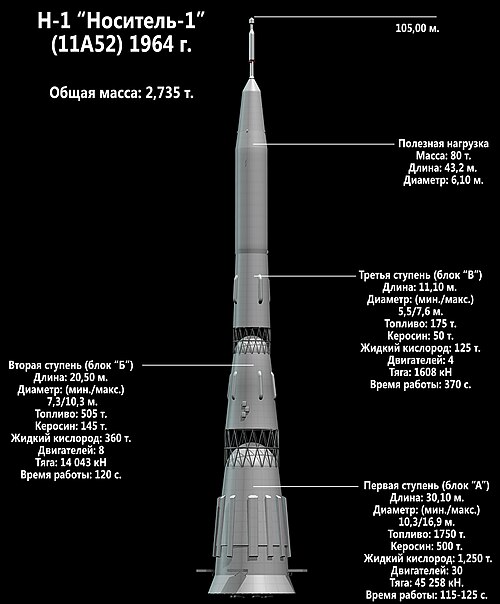
Scheme of the rocket stages (in Russian)
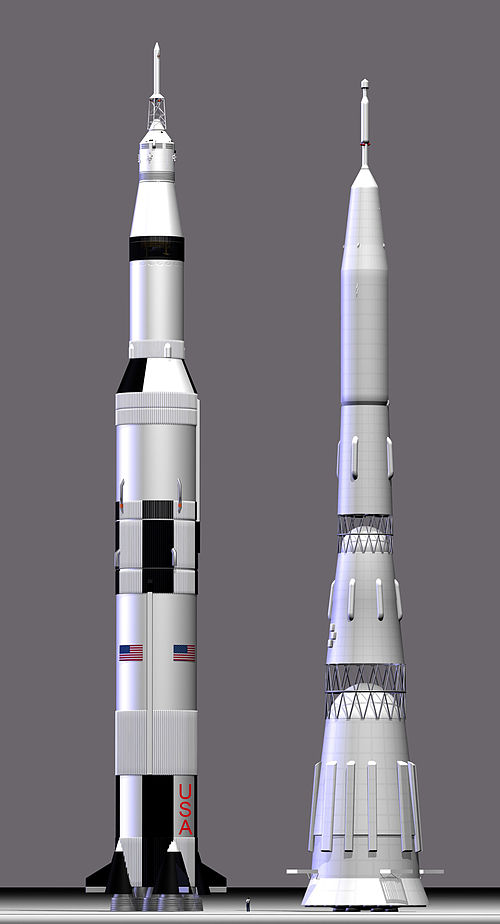
A comparison of the US Saturn V rocket (left) with the Soviet N1/L3. Note: human at bottom illustrates scale
Soviet crewed lunar programs
Videos
The Soviet crewed lunar programs were a series of programs pursued by the Soviet Union to land humans on the Moon, in competition with the United States Apollo program. The Soviet government publicly
N1 (rocket)
…compete with the US Apollo program for a crewed Moon landing, using a similar lunar orbit rendezvous method. The rocket had three stages, carrying the L3 lunar payload into low Earth orbit with two cosmonauts. The L3 contained the Block G trans-lunar injection stage; Block D for mid-course corrections, lunar orbit…

Artist's depiction of TMK-MAVR on a Venus flyby

Zond (Soyuz 7K-L1) circumlunar spacecraft

Soyuz 7K-LOK rendering

LK (Lunniy korabl – "lunar craft" or lunar ship)