National Recording Registry
Videos
Photos
The National Recording Registry is a list of sound recordings that "are culturally, historically, or aesthetically significant, and/or inform or reflect life in the United States." The registry was established by the National Recording Preservation Act of 2000, which created the National Recording Preservation Board, whose members are appointed by the Librarian of Congress. The recordings preserved in the United States National Recording Registry form a registry of recordings selected yearly by the National Recording Preservation Board for preservation in the Library of Congress.

Martin Luther King Jr.'s 1963 "I Have a Dream" speech was one of 50 recordings preserved in 2002, the first year of existence of the United States National Recording Registry.
Library of Congress
Videos
Photos
The Library of Congress (LOC) is a research library in Washington, D.C., that serves as the library and research service of the U.S. Congress and the de facto national library of the United States. Founded in 1800, the library is the United States's oldest federal cultural institution. The library is housed in three elaborate buildings on Capitol Hill. It also maintains a conservation center in Culpeper, Virginia. The library's functions are overseen by the Librarian of Congress, and its buildings are maintained by the Architect of the Capitol. The Library of Congress is one of the largest libraries in the world. Its collections contain approximately 173 million items, and it has more than 3,000 employees. Its collections are "universal, not limited by subject, format, or national boundary, and include research materials from all parts of the world and in more than 470 languages".

Main reading room of the Library's Thomas Jefferson Building

Thomas Jefferson Building being constructed from 1888 to 1894

Library of Congress in the Capitol Building in 1853
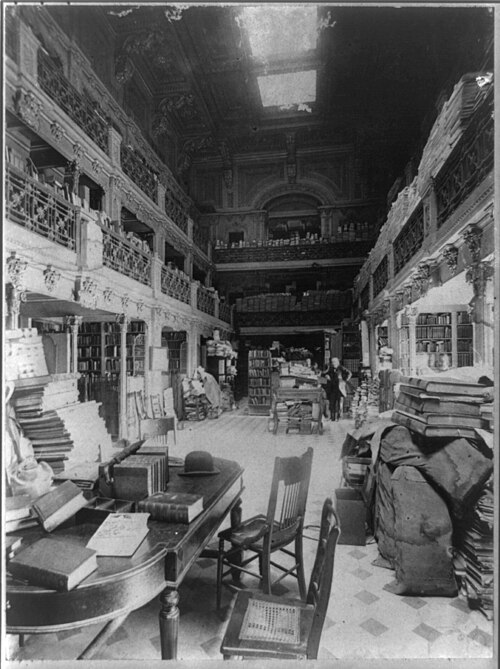
Library of Congress in the Capitol Building in the 1890s