National Revolutionary Army
Videos
The National Revolutionary Army, sometimes shortened to Revolutionary Army (革命軍) before 1928, and as National Army (國軍) after 1928, was the military arm of the Kuomintang from 1925 until 1947 in China during the Republican era. It also became the regular army during the KMT's period of party rule beginning in 1928. It was renamed the Republic of China Armed Forces after the 1947 Constitution, which instituted civilian control of the military.

The opening ceremony of the Whampoa Military Academy, with Sun Yat-sen and Chiang Kai-shek.

NRA troops against Sun Chuanfang's private army preparing to defend Shanghai.
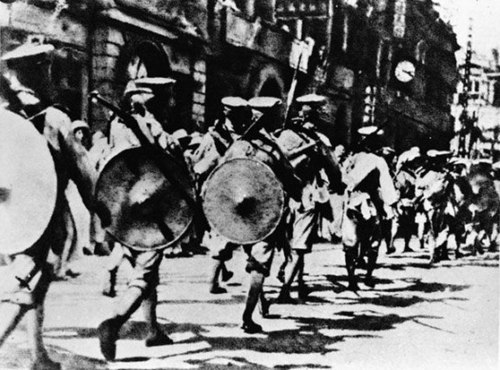
National Revolutionary Army soldiers marched into the British concessions in Hankou during the Northern Expedition.
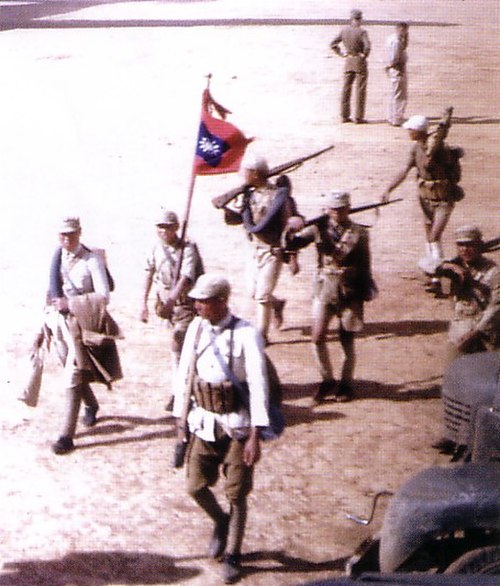
The NRA during World War II
Beiyang Army
Videos
The Beiyang Army, named after the Beiyang region, was a large, Western-style Imperial Chinese Army established by the Qing dynasty government in the late 19th century. It was the centerpiece of a general reconstruction of Qing China's military system. The Beiyang Army played a major role in Chinese politics for at least three decades and arguably right up to 1949. It made the Xinhai Revolution of 1911 possible, and, by dividing into warlord factions known as the Beiyang Clique, ushered in a period of regional division.

The Beiyang Army conducting military exercises in the late Qing dynasty

Beiyang Army troops on parade after 1912

Military training of the Beiyang Army during the 1910s

Yuan Shikai as the Emperor of China (1915–1916).