National personification
Videos
A national personification is an anthropomorphic personification of a state or the people(s) it inhabits. It may appear in political cartoons and propaganda.


The Liberty of Oudiné in memory of the Argentine centenary of the May Revolution (1810-1910).
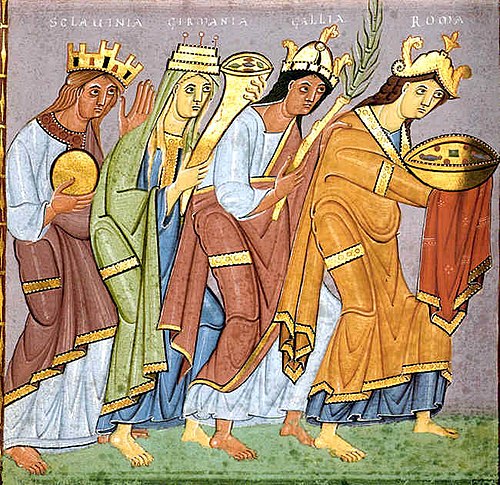
An early example of national personification in a gospel book dated 990: Sclavinia, Germania, Gallia, and Roma, bringing offerings to Emperor Otto III.

Italia und Germania (1828) by Johann Friedrich Overbeck.
John Bull
Videos
John Bull is a national personification of the United Kingdom, especially in political cartoons and similar graphic works. He is usually depicted as a stout, middle-aged, country-dwelling, jolly and matter-of-fact man. He originated in satirical works of the early 18th century and would come to stand for "English liberty" in opposition to revolutionaries. He was popular through the 18th and 19th centuries until the time of the First World War, when he generally stopped being seen as representative of the "common man".


An earlier John Bull in which he is depicted as an anthropomorphic bull

John Bull holds the head of Napoleon Bonaparte in an 1803 caricature by James Gillray.