Naval artillery
Videos
Naval artillery is artillery mounted on a warship, originally used only for naval warfare and then subsequently used for more specialized roles in surface warfare such as naval gunfire support and ant
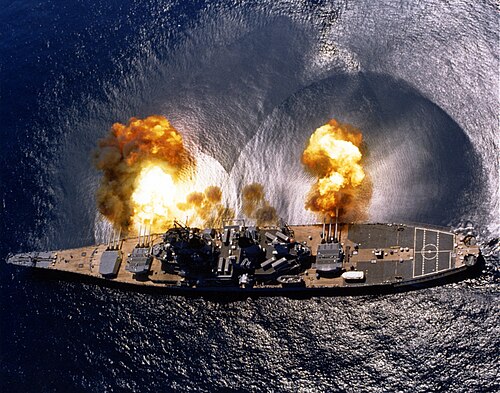
USS Iowa fires a broadside of nine 16"/50 and six 5"/38 guns during an exercise

The cannon shot (c. 1680), by Willem van de Velde the Younger

The line of battle was used from the beginning of the 16th century by the Portuguese, especially in the Indian Ocean, and from the 17th century, by the other Europeans in general, beginning with the Dutch and the English, in the English Channel and the North Sea. Pictured, the Battle of Öland between an allied Danish–Dutch fleet under Cornelis Tromp and the Swedish navy.

Firing of an 18-pounder aboard a French ship
Otobreda 127/54 Compact
Videos
The Otobreda 127mm/54 Compact gun is a dual purpose naval artillery piece built by the Italian company Oto Melara. It uses the 127mm round which is also used in the 5 inch/ 54 gun, albeit that this gu
Naval artillery
…the other defense systems. Modern naval artillery is nevertheless still capable of impressive performances. For example, the Italian 127 mm (~5 inch) Otobreda 127/54 Compact can fire 40 rounds a minute at a range of over 23 kilometres (25,153 yd), or up to 100 kilometres (62 mi) when using rocket-boosted, terminal guided…

Otobreda 127mm/54C on Venezuelan frigate Mariscal Sucre (F-21)