Navigational instrument
Videos
Navigational instruments are instruments used by nautical navigators and pilots as tools of their trade. The purpose of navigation is to ascertain the present position and to determine the speed, dire
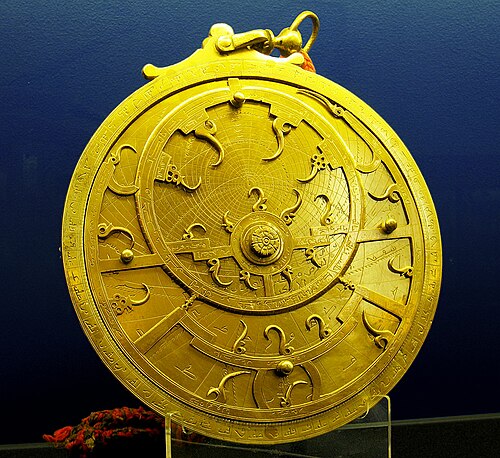
An 18th Century Persian astrolabe – maker unknown. The points of the curved spikes on the front rete plate, mark the positions of the brightest stars. The name of each star being labeled at the base of each spike. The back plate, or mater is engraved with projected coordinate lines. From the Whipple Museum of the History of Science in Cambridge.
Mariner's astrolabe
Videos
The mariner's astrolabe, also called sea astrolabe, was an inclinometer used to determine the latitude of a ship at sea by measuring the sun's noon altitude or the meridian altitude of a star of known
Navigational instrument
…through the center. The observer holds one of the knots in his mouth and extends the board away so that the edges make a constant angle with his eyes. Mariner's astrolabe Derived from the astrolabe, it was developed in late 15th century and found use in the 16th to 17th centuries. It was replaced by the back staff and…

Three Mariner's Astrolabes in the Museum of the Forte da Ponta da Bandeira; Lagos, Portugal

Mariner's astrolabe from circa 1600.

Mariner's astrolabe made in 1645 by Nicolao Ruffo at The Mariners' Museum

Sodré astrolabe, the oldest mariner's astrolabe in National Museum of Oman, Muscat