NeVe 1
Videos
NeVe 1 is a supergiant elliptical galaxy, which is the central, dominant member and brightest cluster galaxy of the Ophiuchus Cluster. It lies at a distance of about 411 million light-years away from

Combined XMM-Newton and GMRT image of the Ophiuchus Cluster, with NeVe 1 being the bright, purple spot. The blue cloud on its lower left is the remnant of the eruption.

The Ophiuchus Cluster with labels included. The central galaxy NeVe 1 is marked by the cross (+), while the dashed line shows the break in its X-ray halo—the boundary of the cavity and its associated radio emission. The image on the lower right by Chandra further details the cavity edge in NeVe 1's X-ray halo. Credit: Chandra, 2MASS, XMM-Newton, GMRT.
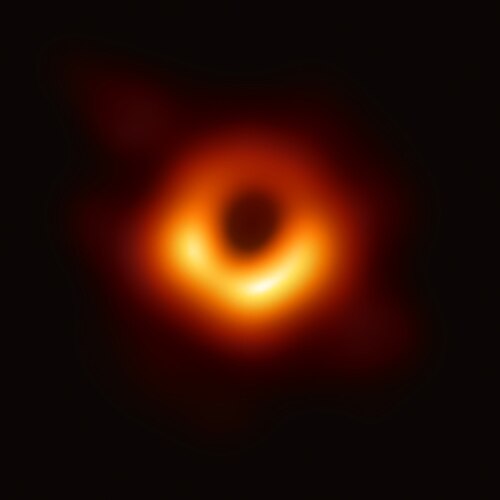
Black hole Messier 87 crop max res
GRB 221009A
Videos
GRB 221009A was an extraordinarily bright and very energetic gamma-ray burst jointly discovered by the Neil Gehrels Swift Observatory and the Fermi Gamma-ray Space Telescope on October 9, 2022. The ga
NeVe 1
…event known. It was five times more energetic than the outburst at the galaxy cluster MS 0735.6+7421, and 4.2 million times more energetic than GRB 221009A—the most energetic gamma-ray burst known. It was a high-energy low-power event, occurring over millions of years. The outburst has been attested to…

Swift's X-ray image of GRB 221009A shows circular rings around the gamma-ray burst. Dust in the Milky Way scattered the x-ray emission of the gamma-ray burst, creating the rings.

Spectra of GRB 221009A with a peak in two of the intervals in red from possible pair annihilation.

Near-simultaneous observations were made of GRB221009A from Gemini South in Chile. The image is a combination of 4 exposures in I, J, H, K with two instruments taken in the morning of Friday, October 14, 2022.

XMM-Newton images recorded 20 dust rings, 19 of which are shown here in arbitrary colors. This composite merges observations made two and five days after GRB 221009A erupted. Dark stripes indicate gaps between the detectors