Nergal
Videos
Nergal was a Mesopotamian god worshiped through all periods of Mesopotamian history, from Early Dynastic to Neo-Babylonian times, with a few attestations indicating that his cult survived into the per
A symbol of Nergal on Old-Babylonian fired clay plaque from Nippur, Southern Mesopotamian, Iraq


A bull-eared deity, possibly a courtier of Nergal

The "sword-god" from Yazılıkaya, identified with Nergal

Syncretic Parthian relief carving of Nergal-Heracles from Hatra in Iraq, dating to the first or second century AD
The ancient Mesopotamian underworld, was the lowermost part of the ancient near eastern cosmos, roughly parallel to the region known as Tartarus from early Greek cosmology. It was described as a dark,
Nergal
…Achaemenid domination. He was primarily associated with war, death, and disease, and has been described as the "god of inflicted death". He reigned over Kur, the Mesopotamian underworld, depending on the myth either on behalf of his parents Enlil and Ninlil, or in later periods as a result of his marriage with the goddess Ereshkigal…
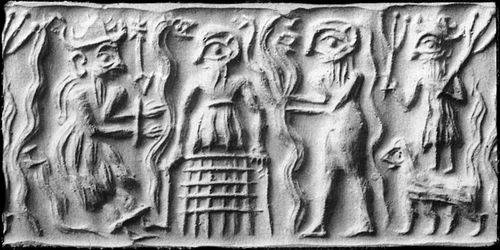
Ancient Sumerian cylinder seal impression showing the god Dumuzid being tortured in the underworld by galla demons

Detail of the "Peace" panel of the Standard of Ur from the Royal Cemetery at Ur, showing a man playing a lyre. The Sumerians believed that, for the highly privileged, music could alleviate the bleak conditions of the underworld.

The "Queen of Night Relief" (c. nineteenth or eighteenth century BC), which is believed to represent either Ereshkigal or her younger sister Inanna

Terracotta plaque dating to the Amorite Period (c. 2000–1600 BC) showing a dead god (probably Dumuzid) resting in his coffin