New Enlightenment (China)
Videos
New Enlightenment, or the New Enlightenment movement, was a massive social and cultural movement in mainland China that originated in the late 1970s and lasted for over a decade. Growing out of the 19

A slogan in the former residence of Hu Yaobang, who was the General Secretary of the Chinese Communist Party from 1982 to early 1987.

Nothing to My Name (1986) by Cui Jian, the "Father of Chinese rock", was regarded as the beginning of Chinese rock music. The song became a symbol of the 1980s of China, and rock music was viewed as one of the most direct forms of enlightenment in China.

Pu Zhiqiang publicly defended the World Economic Herald, which was forcibly shut down by Jiang Zemin in Shanghai before the Tiananmen Square massacre in 1989.

Leaders of the fifth generation of Chinese filmmakers: Zhang Yimou (left) and Chen Kaige (right)
On 1 October 1949 CCP chairman Mao Zedong proclaimed the People's Republic of China from atop Tiananmen, after a near complete victory by the Chinese Communist Party in the Chinese Civil War. The PRC
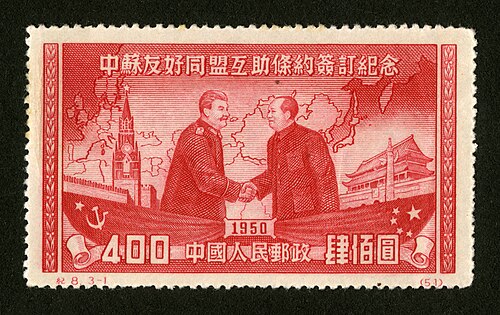
On October 2, 1949, the Soviet Union was the first country to officially recognized the People's Republic of China after its establishment.

Backyard furnaces were commonly used to produce steel during the Great Leap Forward.

Red Guards on Tiananmen Square during the Cultural Revolution (1967)
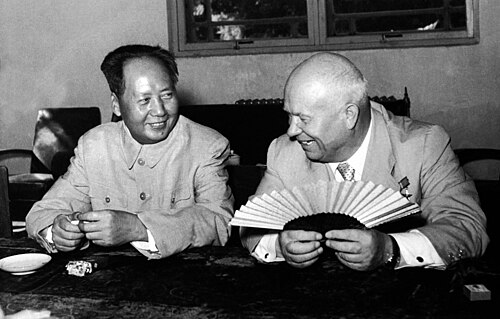
Soviet leader Nikita Khrushchev visited PRC and met with Mao Zedong in 1958.