Newton's laws of motion
Videos
Newton's laws of motion are three physical laws that describe the relationship between the motion of an object and the forces acting on it. These laws, which provide the basis for Newtonian mechanics,
Artificial satellites move along curved orbits, rather than in straight lines, because of the Earth's gravity.

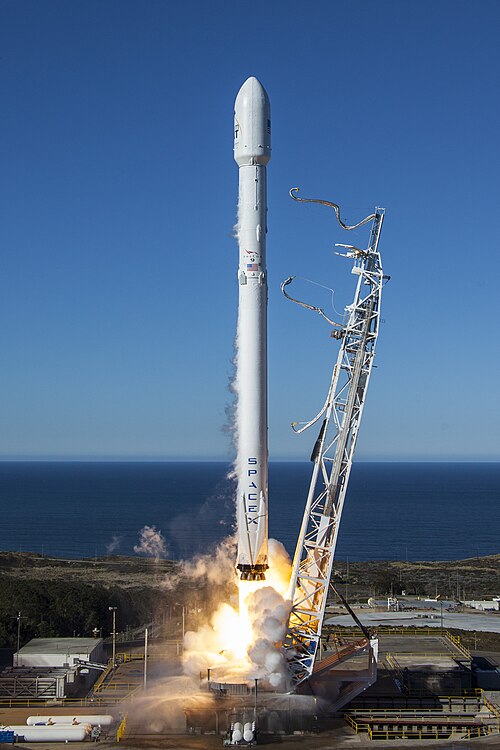
Rockets work by creating unbalanced high pressure that pushes the rocket upwards while exhaust gas exits through an open nozzle.

A bouncing ball photographed at 25 frames per second using a stroboscopic flash. In between bounces, the ball's height as a function of time is close to being a parabola, deviating from a parabolic arc because of air resistance, spin, and deformation into a non-spherical shape upon impact.

Rockets, like the Space Shuttle Atlantis, expel mass during operation. This means that the mass being pushed, the rocket and its remaining onboard fuel supply, is constantly changing.
Momentum
Videos
In Newtonian mechanics, momentum is the product of the mass and velocity of an object. It is a vector quantity, possessing a magnitude and a direction. If m is an object's mass and v is its velocity,
Newton's laws of motion
…any instant of time, the net force on a body is equal to the body's acceleration multiplied by its mass or, equivalently, the rate at which the body's momentum is changing with time. If two bodies exert forces on each other, these forces have the same magnitude but opposite directions…

Momentum of a pool cue ball is transferred to the racked balls after collision.

Ibn Sīnā (980–1037)

René Descartes (1596–1650)

Christiaan Huygens (1629–1695)