Nickel
Videos
Nickel is a chemical element; it has symbol Ni and atomic number 28. It is a silvery-white lustrous metal with a slight golden tinge. Nickel is a hard and ductile transition metal. Pure nickel is chem

Nickel electrolytic and 1cm 3 cube

Electron micrograph of a Ni nanocrystal inside a single wall carbon nanotube; scale bar 5 nm
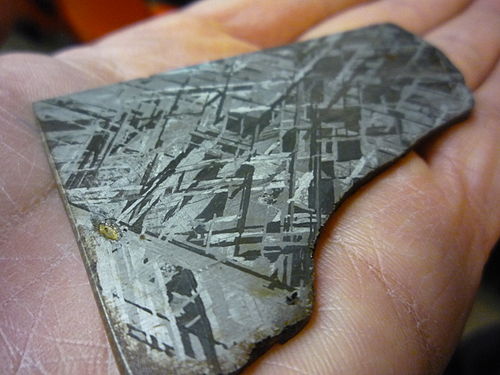
Widmanstätten pattern showing the two forms of nickel–iron, kamacite and taenite, in an octahedrite meteorite
![Color of various Ni(II) complexes in aqueous solution. From left to right, [Ni(NH3)6]2+, [Ni(NH2CH2CH2NH2)3]2+, [Ni(H2O)5Cl]+, [Ni(H2O)6]2+](https://upload.wikimedia.org/wikipedia/commons/thumb/f/ff/Color_of_various_Ni%28II%29_complexes_in_aqueous_solution.jpg/500px-Color_of_various_Ni%28II%29_complexes_in_aqueous_solution.jpg)
Color of various Ni(II) complexes in aqueous solution. From left to right, [Ni(NH3)6]2+, [Ni(NH2CH2CH2NH2)3]2+, [Ni(H2O)5Cl]+, [Ni(H2O)6]2+
Stainless steel
Videos
Stainless steel is an iron-based alloy that contains chromium, making it resistant to rust and corrosion. Alternatively, it is known as inox, corrosion-resistant steel, Nirosta or rustless steel. Stai
Nickel
…permanent magnets and rare-earth magnets. The metal is used chiefly in alloys and corrosion-resistant plating. About 68% of world production is used in stainless steel. A further 10% is used for nickel-based and copper-based alloys, 9% for plating, 7% for alloy steels, 3% in foundries, and 4% in other applications…

Stainless steel taps and sink

Stainless steel is used for industrial equipment when it is important that the equipment is durable and easy to clean.

An announcement, as it appeared in a 1915 issue of The New York Times, of the development of stainless steel in Sheffield, England

Monument to Harry Brearley at the former Brown Firth Research Laboratory in Sheffield, England