The Niedermayer–Hentig Expedition, also known as the Kabul Mission, was a diplomatic mission to Afghanistan sent by the Central Powers in 1915–1916. The purpose was to encourage Afghanistan to declare
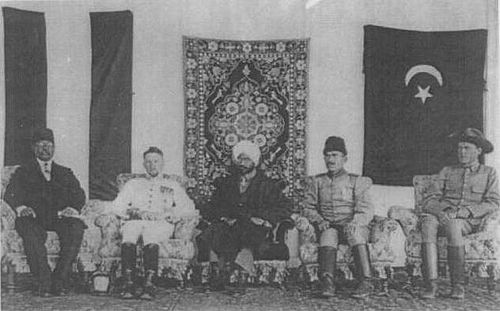
Mahendra Pratap, centre, with (left to right) Maulavi Barkatullah, Werner Otto von Hentig, Kazim Bey, and Walter Röhr. Kabul, 1916

Mehmed V, the Sultan of Turkey, was then regarded as the Caliph by a substantial part of the Islamic world.

Habibullah Khan, Emir of Afghanistan during World War I. Habibullah was closely allied to British India.

A column of troops of the Sistan force at Gusht in July 1916. The Force was then commanded by Reginald Dyer, later notorious for having ordered the Amritsar massacre.
Mohamed Barakatullah Bhopali
Videos
Mohamed Barakatullah Bhopali, known with his honorific as Maulana Barkatullah, was an Indian revolutionary from Bhopal. Barkatullah was born on 7 July 1854 at Itawra mohalla, Bhopal in what is today M
Ghadar di gunj
