Ninlil
Videos
Ninlil was a Mesopotamian goddess regarded as the wife of Enlil. She shared many of his functions, especially the responsibility for declaring destinies, and like him was regarded as a senior deity an

Ruins of a temple at the site of ancient Nippur (Tell Nuffar), one of the cities associated with Ninlil

Drawing of an impression of a cylinder seal of Bur-Suen, a king whose devotion to Sud is mentioned in a hymn dedicated to her.
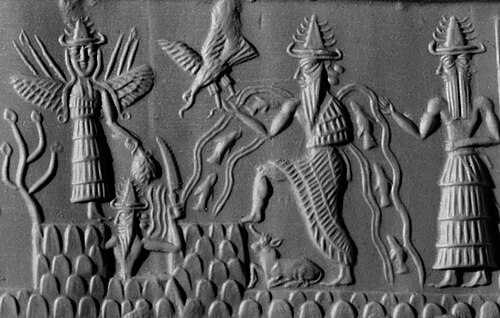
Ea En Ki
Sin (mythology)
Videos
Sin or Suen also known as Nanna is the Mesopotamian god representing the moon. While these two names originate in two different languages, respectively Akkadian and Sumerian, they were already used in
Ninlil
…as a senior deity and head of the pantheon. She is also well attested as the mother of his children, such as the underworld god Nergal, the moon god Nanna or the warrior god Ninurta. She was chiefly worshiped in Nippur and nearby Tummal alongside Enlil, and multiple temples and shrines dedicated to her…

Impression of the cylinder seal of Ḫašḫamer, ensi (governor) of Iškun-Sin c. 2100 BCE. The seated figure is probably king Ur-Nammu, bestowing the governorship on Ḫašḫamer, who is led before him by Lamma (protective goddess). Sin himself is indicated in the form of a crescent.

Symbols representing Sin (center), Ishtar (left) and Shamash (right), as depicted on the upper half of a kudurru of Meli-Shipak II.

A relief of Kušuḫ (right), the Hurrian moon god, from Yazılıkaya

A relief depicting the offering of a libation to the Anatolian moon god Arma (right).