The term Norman–Arab–Byzantine culture, Norman–Sicilian culture or, less inclusively, Norman–Arab culture, refers to the interaction of the Norman, Byzantine Greek, Latin, and Arab cultures following the Norman conquest of the former Emirate of Sicily and North Africa from 1061 to around 1250. The civilization resulted from numerous exchanges in the cultural and scientific fields, based on the tolerance shown by the Normans towards the Latin- and Greek-speaking Christian populations and the former Arab Muslim settlers. As a result, Sicily under the Normans became a crossroad for the interaction between the Norman and Latin Catholic, Byzantine–Orthodox, and Arab–Islamic cultures.


Byzantine–style mosaic of Christ Pantokrator in the Cefalù Cathedral, erected by Roger II in 1131
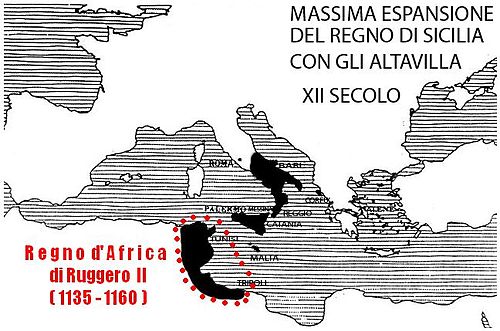
The Kingdom of Africa (in Italian: Regno d'Africa) pinpointed in red

Arabic–style fresco in the Cappella Palatina, Palermo.
Cefalù Cathedral
Videos
The Cathedral of Cefalù is a Roman Catholic basilica in Cefalù, Sicily. It is one of nine structures included in the UNESCO World Heritage Site known as Arab-Norman Palermo and the Cathedral Churches of Cefalù and Monreale.

The façade of the cathedral

Cefalù Cathedral within the town

Lateral view

Interior view towards the chancel