Norman and medieval London
Videos
Photos
This article covers the history of London from the Norman conquest of England in 1066 to the death of Richard III in 1485. During this period, London became the capital of England, as monarchs held Parliament at the Palace of Westminster, beginning in 1265 and increasing over the 14th century. London appointed its first recorded Lord Mayor in this period, Henry FitzAilwin, in 1189. In the 12th century, the writer William Fitzstephen described it as florilegium urbanum — "flower of cities".
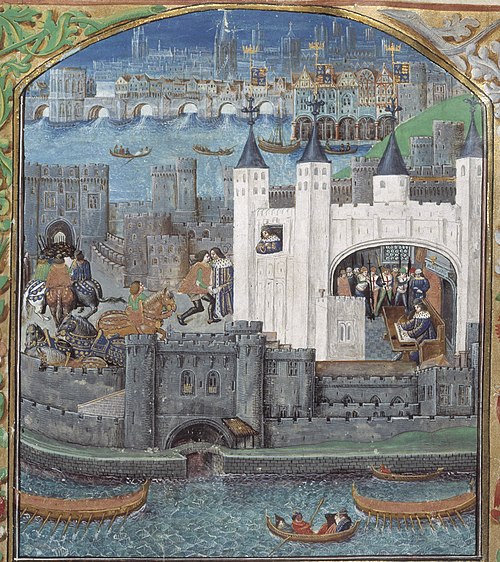
London as depicted in a 15th-century manuscript, showing the Tower of London, the River Thames, and London Bridge.

A model of London Bridge as it appeared in 1440

The interior of St. Bartholomew-the-Great, founded in 1123, with rounded arches indicative of the Norman style

The White Tower of the Tower of London, built in the late 11th century
Savoy Palace
Videos
Photos
The Savoy Palace, considered the grandest nobleman's townhouse of medieval London, was the residence of prince John of Gaunt until it was destroyed during rioting in the Peasants' Revolt of 1381. The palace was on the site of an estate given to Peter II, Count of Savoy, in the mid-13th century, which in the following century came to be controlled by Gaunt's family. It was situated between the Strand and the River Thames. The Tudor-era Savoy Chapel was located on the former estate property and carried on the name; today, the name is carried on by the Savoy Theatre and Savoy Hotel, again both located on the former estate. In the locality of the palace, the administration of law was by a special jurisdiction, separate from the rest of the county of Middlesex, known as the Liberty of the Savoy. French monarch John II of France died here after an illness.

1848 engraving by Charles Thurston Thompson

The Savoy Hospital in 1650, drawn by Wenceslaus Hollar

View of the Savoy in 1736, from Vetusta Monumenta.

Ruin of the main Barracks (formerly Hospital) building in the late 18th century, following the fire.