In the Indian Ocean north of the equator, tropical cyclones can form throughout the year on either side of the Indian subcontinent, although most frequently between April and June, and between October

Very severe cyclonic storms Luban (left) and Titli (right) over the Arabian Sea and the Bay of Bengal in October 2018

The 1999 Odisha Cyclone making landfall over Odisha in 1999.
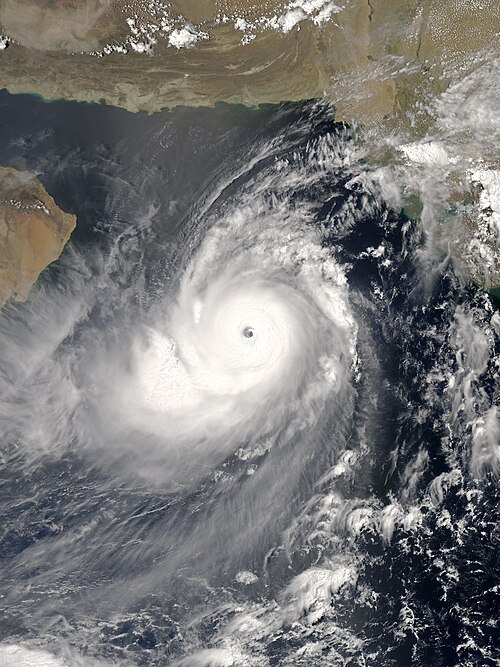
Cyclone Gonu at its peak in 2007.

Cyclone Kyarr was the first super cyclone since 2007.
Tropical cyclone
Videos
A tropical cyclone is a rapidly rotating storm system with a low-pressure area, a closed low-level atmospheric circulation, strong winds, and a spiral arrangement of thunderstorms that produce heavy r
North Indian Ocean tropical cyclone
…In the Indian Ocean north of the equator, tropical cyclones can form throughout the year on either side of the Indian subcontinent, although most frequently between April and June, and between October and December…

Hurricane Florence viewed from the International Space Station in 2018. The eye, eyewall, and surrounding rainbands are characteristics of tropical cyclones.

Hurricane Paulette, in 2020, is an example of a sheared tropical cyclone, with deep convection slightly removed from the center of the system.

Three tropical cyclones of the 2006 Pacific typhoon season at different stages of development. The weakest (left) demonstrates only the most basic circular shape. A stronger storm (top right) demonstrates spiral banding and increased centralization, while the strongest (lower right) has developed an eye.
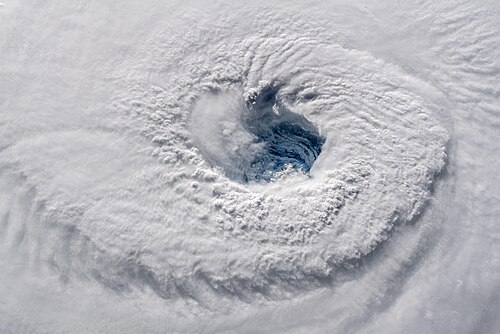
The eye and surrounding clouds of Hurricane Florence seen from the International Space Station