November 2009 nor'easter
Videos
The November 2009 nor'easter was a powerful autumn nor'easter that caused widespread damage throughout the east coast of the United States. This extratropical cyclone formed in relation to Hurricane Ida's remnant mid-level circulation across southeastern Georgia and moved east-northeast offshore North Carolina, before slowly dropping south and southeast over the succeeding several days. The system eventually dissipated on November 17.

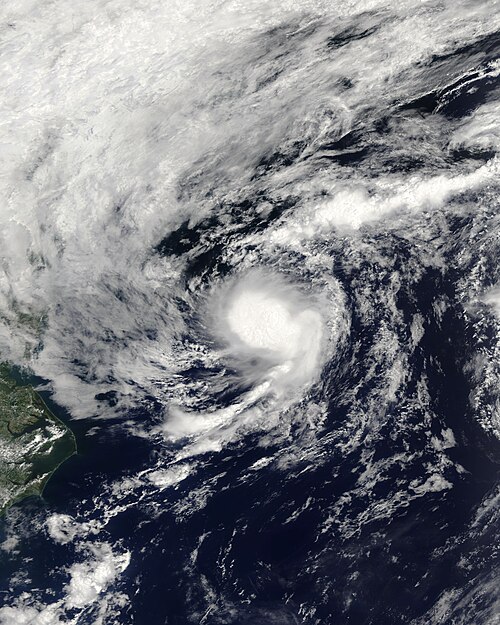
Satellite image of the storm on November 12

Before and after images of a beach in Virginia depicting the severity of beach erosion
The 2009 Atlantic hurricane season was a near-average Atlantic hurricane season that produced eleven tropical cyclones, nine named storms, three hurricanes, and two major hurricanes. It officially began on June 1 and ended on November 30, dates that conventionally delimit the period of each year when most tropical cyclones develop in the Atlantic basin. The season's first tropical cyclone, Tropical Depression One, developed on May 28, while the final storm, Hurricane Ida, dissipated on November 10. The most intense hurricane, Bill, was a powerful Cape Verde-type hurricane that affected areas from the Leeward Islands to Newfoundland. The season featured the lowest number of tropical cyclones since the 1997 season, and only one system, Claudette, made landfall in the United States. Forming from the interaction of a tropical wave and an upper-level low, Claudette made landfall on the Florida Panhandle with maximum sustained winds of 45 mph (70 km/h) before quickly dissipating over Alabama. The storm killed two people and caused $228,000 in damage.