The Nubian Sandstone Aquifer System is the world's largest known fossil water aquifer system. It is located underground in the eastern end of the Sahara desert and spans the political boundaries of fo

The transport of pipe segments for the Great Man-Made River (GMMR) in the Sahara desert, Libya, during the 1980s. A network of pipes that supplies water from the Nubian Sandstone Aquifer System, a fossil aquifer in the Sahara desert of Libya, the GMMR is the world's largest irrigation project.

Nubian Sandstone Aquifer System
African humid period
Videos
The African humid period was a climate period in Africa during the late Pleistocene and Holocene geologic epochs, when North Africa was wetter than it is today. The covering of much of the Sahara by g
Nubian Sandstone Aquifer System
…Lake Ptolemy African humid period Essay and Maps: Groundwater Resources of the Nubian Aquifer System…
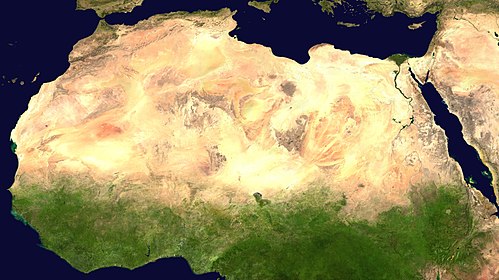
The modern, arid Sahara. The Sahara was not a desert during the African humid period. Instead, most of North Africa was covered by grass, trees, and lakes.

A present-day savannah, Tarangire National Park, Tanzania

Images of swimming people in the Cave of Swimmers

The Lakes of Ounianga are recharged from fossil groundwater that originated partly during the AHP