The United Kingdom became the third country to develop and, in 1952, test nuclear weapons. The UK is one of nine nuclear-armed states, and one of five recognized by the Treaty on the Non-Proliferation

HMS Victorious, one of four nuclear-armed ballistic missile submarines of the Trident programme
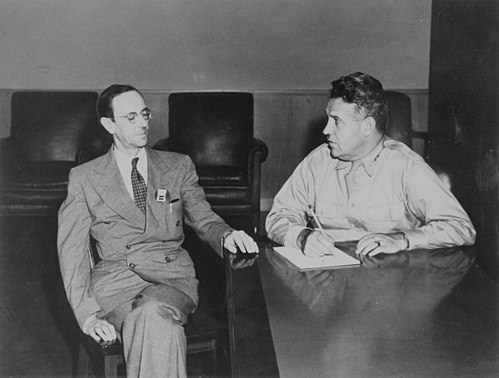
James Chadwick (left), the head of the British Mission, confers with Major General Leslie R. Groves, Jr. (right), the director of the Manhattan Project

President Harry Truman and the prime ministers Clement Attlee and Mackenzie King boarding USS Sequoia for discussions about nuclear weapons, November 1945

William Penney, Chief Superintendent Armament Research, was in charge of atomic bomb development.
Following the success of Operation Grapple in which the United Kingdom became the third nation to acquire thermonuclear weapons after the United States and the Soviet Union, Britain launched negotiati
Nuclear weapons of the United Kingdom
…Explosive Research, testing its first nuclear weapon in 1952. In total the UK conducted 45 nuclear tests, 12 in Australia, 9 in the Pacific, and 24 at the Nevada Test Site, with its last in 1991. The UK and France are the only two nuclear-armed countries that have ratified the Comprehensive Nuclear-Test-Ban Treaty. The…

Krakatau subcritical experiment being lowered into the floor of the tunnel of the U1a Complex at the Nevada Test Site (2006). The cables extending from the hole will carry data from the experiment to recording instruments.

Preparing for an underground test at the Nevada Test Site. Final test preparations include running miles of cable downhole which will transmit vital test information to the diagnostic trailers to the left. A rack containing instrumentation to go downhole is assembled in the tower to the right. Subsidence craters from earlier underground tests dot the landscape.

The Krakatau subcritical experiment is prepared to be lowered into the tunnel of the U1a Complex at the Nevada Test Site