Nuclear winter
Videos
Nuclear winter is a severe and prolonged global climatic cooling effect that is hypothesized to occur after widespread urban firestorms following a large-scale nuclear war. The hypothesis is based on

Pyrocumulonimbus cloud formed by the firestorm following the atomic bombing of Hiroshima, 1945. Nuclear winter effects are triggered by at least a hundred such city firestorms.

Picture of a pyrocumulonimbus cloud taken from a commercial airliner cruising at about 10 km. In 2002, various sensing instruments detected 17 distinct pyrocumulonimbus cloud events in North America alone.

Smoke rising in Lochcarron, Scotland, is stopped by an overlying natural low-level inversion layer of warmer air (2006).

Diagram obtained by the CIA from the International Seminar on Nuclear War in Italy 1984. It depicts the findings of Soviet 3-D computer model research on nuclear winter from 1983, and although containing similar errors as earlier Western models, it was the first 3-D model of nuclear winter. (The three dimensions in the model are longitude, latitude and altitude.) The diagram shows the models predictions of global temperature changes after a global nuclear exchange. The top image shows effects after 40 days, the bottom after 243 days. A co-author was nuclear winter modelling pioneer
Nuclear warfare
Videos
Nuclear warfare, also known as atomic warfare, is a military conflict or prepared political strategy that deploys nuclear weaponry. Nuclear weapons are weapons of mass destruction; in contrast to conv
Nuclear winter
…winter is a severe and prolonged global climatic cooling effect that is hypothesized to occur after widespread urban firestorms following a large-scale nuclear war. The hypothesis is based on the fact that such fires can inject soot into the stratosphere, where it can block some direct sunlight from reaching the…
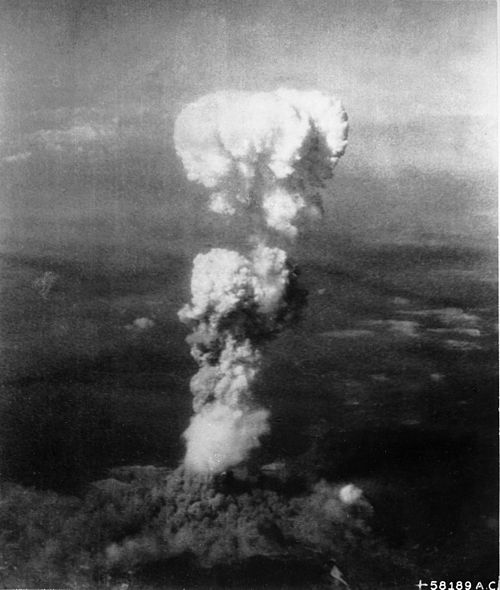
The mushroom cloud over Hiroshima following the detonation of the Little Boy nuclear bomb on 6 August 1945. The atomic bombings of Hiroshima and Nagasaki remain the first and only wartime uses of nuclear weapons in history.
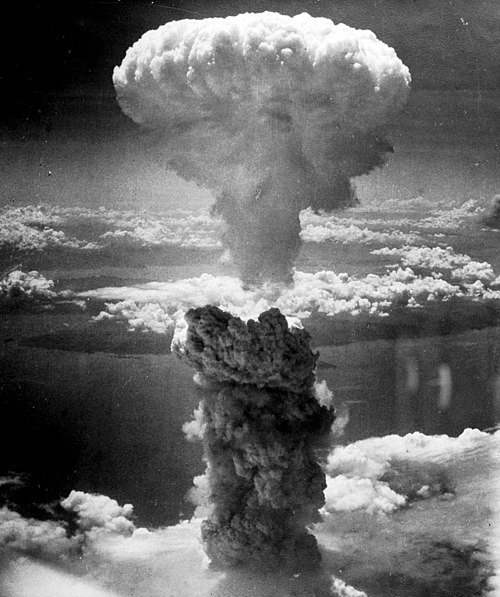
Mushroom cloud from the atomic explosion over Nagasaki rising 18,000 m (59,000 ft) into the air on the morning of August 9, 1945

A photograph of Sumiteru Taniguchi's back injuries taken in January 1946 by a U.S. Marine photographer

Hypocenter of Atomic bomb in Nagasaki