The nucleon magnetic moments are the intrinsic magnetic dipole moments of the proton and neutron, symbols μp and μn. The nucleus of an atom comprises protons and neutrons, both nucleons that behave as small magnets. Their magnetic strengths are measured by their magnetic moments. The nucleons interact with normal matter through either the nuclear force or their magnetic moments, with the charged proton also interacting by the Coulomb force.
Schematic diagram depicting the spin of the neutron as the black arrow and magnetic field lines associated with the neutron's magnetic moment. The spin of the neutron is upward in this diagram, but the magnetic field lines at the center of the dipole are downward.
Direction of Larmor precession for a neutron. The central arrow denotes the magnetic field, the small red arrow the spin of the neutron.
The neutron is a subatomic particle, symbol n or n0, which has a neutral charge, and a mass slightly greater than that of a proton. Protons and neutrons constitute the nuclei of atoms. Since protons and neutrons behave similarly within the nucleus, they are both referred to as nucleons. Nucleons have a mass of approximately one atomic mass unit, or dalton. Their properties and interactions are described by nuclear physics. Protons and neutrons are not elementary particles; each is composed of three quarks.
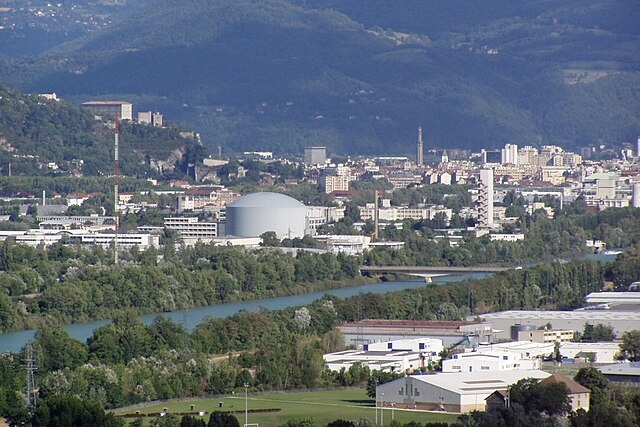
Institut Laue–Langevin (ILL) in Grenoble, France – a major neutron research facility
Cold neutron source providing neutrons at about the temperature of liquid hydrogen