Nueva Planta decrees
Videos
The Nueva Planta decrees were a number of decrees signed between 1707 and 1716 by Philip V, the first Bourbon King of Spain, during and shortly after the end of the War of the Spanish Succession by th
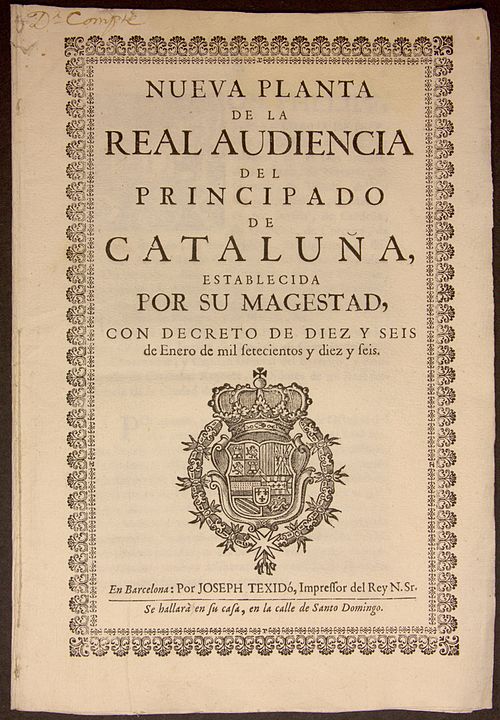
Cover of the Nueva Planta decrees of the Principality of Catalonia

Absolutist government system imposed in Catalonia via Nueva Planta, based on three political institutions: The new Royal Audience to enforce the law, the Captain-General who also led the army that guaranteed the occupation, and the Superintendent who collected the heavy taxation that was imposed on the Principality. Most local appointments depended directly on the King
Spain
Videos
Spain, officially the Kingdom of Spain, is a country in Southern and Western Europe with territories in North Africa. Featuring the southernmost point of continental Europe, it is the largest country
Nueva Planta decrees
…most praiseworthy in all the Universe" according to the 1707 decree), embedding those regions into a new and nearly uniformly administered, centralised Spain. The other historic territories (Navarre and the other Basque territories) supported Philip V initially, whom they saw as belonging to the lineage of…

Celtic castro in Galicia

The Roman Theatre in Mérida

Royal Pantheon of San Isidoro, Kingdom of León

Catholic Monarchs of Spain