Nuno Gonçalves
Videos
Photos
Nuno Gonçalves was a Portuguese artist whose work initiated the Portuguese Renaissance in painting. He was court painter for Afonso V of Portugal from 1450 to 1471, and in 1471 he was appointed the official painter for the city of Lisbon. His surviving masterpiece is the polyptych known as the Saint Vincent Panels.

Saint Vincent Panels, Lisbon

Saint Paul, by Nuno Gonçalves
Court painter
Videos
Photos
A court painter was an artist who painted for the members of a royal or princely family, sometimes on a fixed salary and on an exclusive basis where the artist was not supposed to undertake other work. Painters were the most common, but the court artist might also be a court sculptor. In Western Europe, the role began to emerge in the mid-13th century. By the Renaissance, portraits, mainly of the family, made up an increasingly large part of their commissions, and in the early modern period one person might be appointed solely to do portraits, and another for other work, such as decorating new buildings.

Las Meninas, Diego Velázquez, 1656, shows a princess watching her unseen parents as Velázquez paints them; the cross on his chest was added later, according to legend painted by the king himself, after the artist received the Order of Santiago in 1659 (click on image and run cursor over to identify figures).

Don Carlos by Alonso Sánchez Coello, 1564. Sent to Vienna in an unsuccessful attempt to promote a marriage.

Court style panorama Along the River During the Qingming Festival, an 18th-century copy (the "Qing Court Version") of the 12th century Song dynasty original by Zhang Zeduan. Zhang's original painting is revered by scholars as "one of Chinese civilization’s greatest masterpieces." The scroll begins at the right end, and culminates above as the Emperor boards his yacht to join the festive boats on the river. The scroll is over 10 metres long (35.6 × 1152.8 cm)
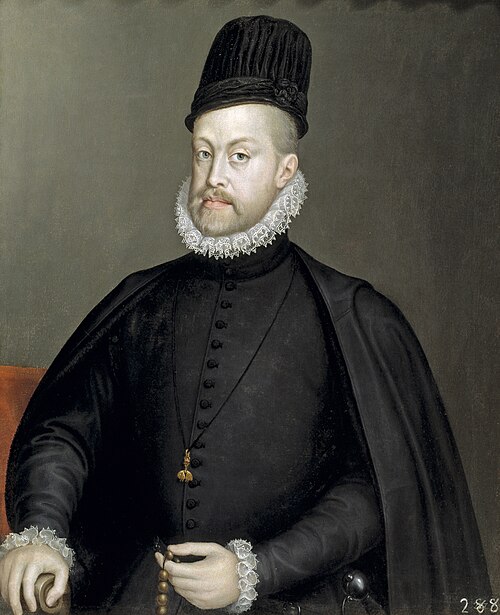
The Prado Philip II, now recognised as by Sofonisba Anguissola