Oak
Videos
An oak is a hardwood tree or shrub in the genus Quercus of the beech family. They have spirally arranged leaves, often with lobed edges, and a nut called an acorn, borne within a cup. The genus is wid
Quercus robur
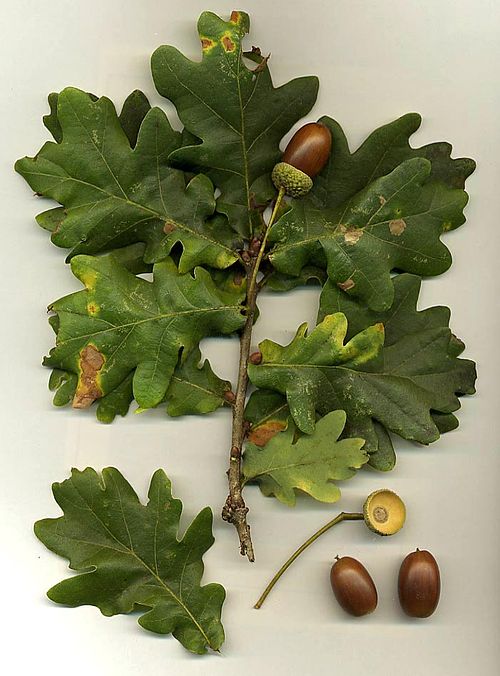
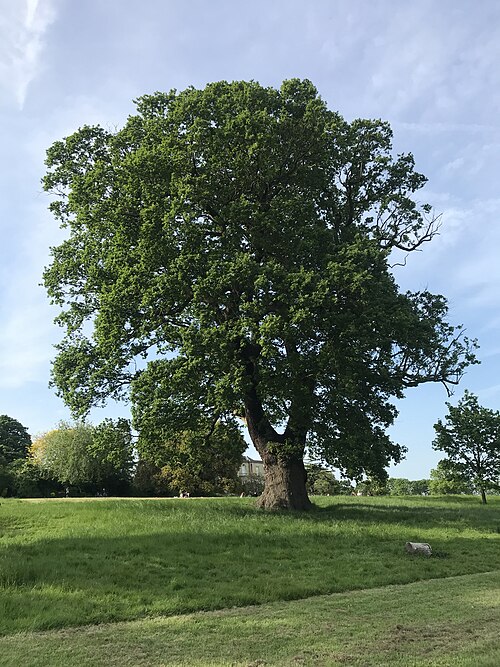
Quercus robur habit
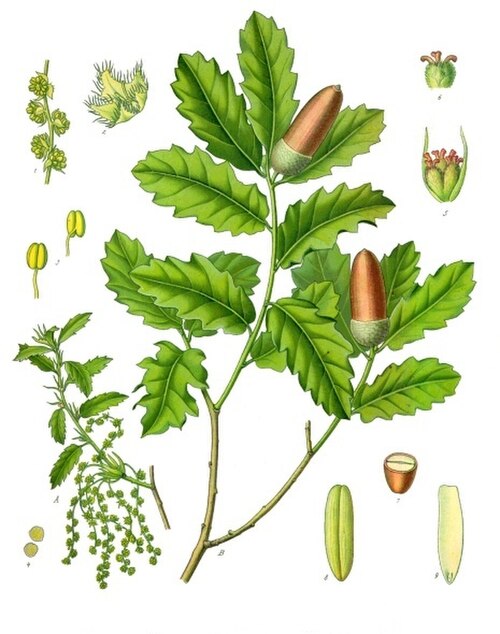
Illustration of Q. lusitanica showing staminate (left) and pistillate flowers (right)

Catkins of Q. alba containing the staminate or 'male' flowers
Acorn
Videos
The acorn is the nut of the oaks and their close relatives; alternatively known as glans. It usually contains a seedling surrounded by two cotyledons, enclosed in a tough shell known as the pericarp,
Oak
…is a hardwood tree or shrub in the genus Quercus of the beech family. They have spirally arranged leaves, often with lobed edges, and a nut called an acorn, borne within a cup. The genus is widely distributed in the Northern Hemisphere, with some 500 species, both deciduous and evergreen. Fossil oaks date…

English oak acorn

Acorns of the willow oak in South Carolina (from small to large, counterclockwise from center): Q. phellos (willow oak), Q. falcata (southern red oak; top right), Q. alba (white oak), and Q. coccinea (scarlet oak). Scale bar at upper right is 1 cm.

Diagram of the anatomy of an acorn: A.) Cupule B.) Pericarp (fruit wall) C.) Seed coat (testa) D.) Cotyledons (2) E.) Plumule F.) Radicle G.) Remains of style. Together D., E., and F. make up the embryo.

Horses eating acorns. Acorns can cause painful death in equines, especially if eaten in excess.