Occupation of the Ruhr
Videos
The occupation of the Ruhr was the period from 11 January 1923 to 25 August 1925 when French and Belgian troops occupied the Ruhr region of Germany.

Two French soldiers and a German civilian in the Ruhr in 1923
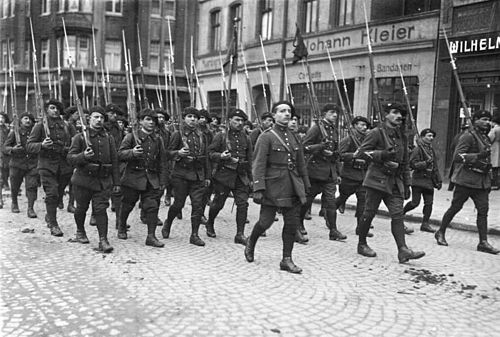
French Chasseurs Alpins in Buer (Gelsenkirchen)

Protest poster from 1923 showing a worker refusing French orders: "No! You will not force me!"

French troops leaving Dortmund
Beer Hall Putsch
Videos
The Beer Hall Putsch, also known as the Munich Putsch, was a failed coup d'état led by Nazi Party leader Adolf Hitler, General Erich Ludendorff, and other Kampfbund leaders in Munich, Bavaria, on 8–9
Occupation of the Ruhr
…to the growth of radical right-wing movements in Germany. Adolf Hitler and the Nazi Party used the occupation as part of their justification for the Beer Hall Putsch of November 1923, which brought them wide public attention for the first time. Under the terms of the Treaty of Versailles (1919) which formally ended…

Nazis at the Marienplatz in Munich during the Putsch

Erich Ludendorff on the cover of Time, 19 November 1923

Odeonsplatz in Munich, 9 November

Early Nazis who participated in the attempt to seize power during the 1923 Putsch