Octoechos (liturgy)
Videos
The Octoechos book is a liturgical book containing a repertoire of hymns ordered in eight parts according to eight echoi. Originally created in the Monastery of Stoudios during the 9th century as a hy

Papyrus fragment of a 6th-century tropologion found in Egypt, marked in red are the modal signature and some early ekphonetic signs of the following theotokion ("another one") which is composed in a melos of echos plagios devteros (D-Bk P. 21319)
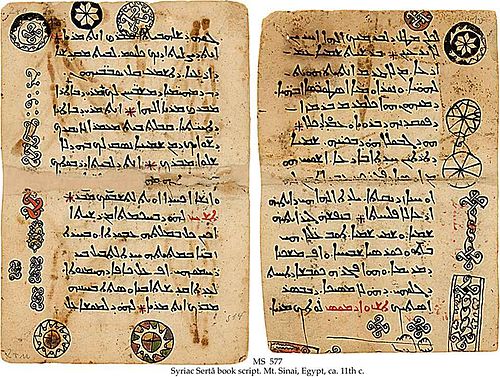
Melkite Heirmologion, written in Syriac language, using Sertâ book script at Saint Catherine's Monastery, Mount Sinai (11th century) Oslo, Schøyen Collection, Ms. 577.

Georgian Iadgari (tropologion, 10th century)

The first printed Octoechos (Schweipolt Fiol, Kraków 1491)
Idiomelon
Videos
Idiomelon —pl. idiomela—is a type of sticheron found in the liturgical books used in the Eastern Orthodox Church, the Eastern Catholic Churches which follow the Byzantine Rite, and many other Orthodox
Octoechos (liturgy)
…metric accentuation are composed as a well-known hymn tune or sticheron avtomelon within the melos of a certain echos. These melodic stichera are called automela, because they can easily be adapted to other texts, even if the number of syllables of verse varies—the so-called prosomoia. The prooimion which precedes…

Avtomelon παντὰς ὑπερβάλλων (echos devteros) adapted to the verses of two Prosomoia—notated in an Octoechos of a 15th-century Sticherarion of the Pantokratorou monastery (GB-Ctc Ms. B.11.17, f. 283r)

Mar Saba at Palestine — an important centre of monastic hymnography

Menaion with two kathismata (echos tritos and tetartos) dedicated to Saint Eudokia (1 March) and the sticheron prosomoion χαῖροις ἡ νοητῇ χελιδῶν in ēchos plagios prōtos which has to be sung with the melos of the avtomelon χαῖροις ἀσκητικῶν. The scribe rubrified the book Τροπολόγιον σῦν Θεῷ τῶν μηνῶν δυῶν μαρτίου καὶ ἀπριλλίου (ET-MSsc Ms. Gr. 607, ff. 2v-3r)

Kontakion Ἡ παρθένος σήμερον (Дѣва дньсь пребогата ражаѥть) for Nativity (25 December) in echos tritos and their prosomoia (podobni): the Resurrection kontakion, the kondak for Boris and Gleb (24 July) and Nicholas (6 December) kontakion (RUS-SPsc Ms. Q.п.I.32, ff.52 & 76; ET-MSsc Ms. Gr. 1280, ff.131r-132v & 117v-119r; Ms. Gr. 1314, f.212)