Okobo
Videos
Okobo, also referred to as pokkuri, bokkuri, or koppori geta, are traditional Japanese wooden sandals worn by young girls for Shichi-Go-San, young women during Coming of Age Day and apprentice geisha

A pair of okobo with a woven bamboo top surface

Side view of another pair. Red-gold-green brocade hanao, wood lacquered in red with gold and green decoration

The same pair as adjacent, showing takagawa omote (four-warp woven bamboo-skin topsole; see zōri)

The same pair from below, showing maegane more clearly than side view
Waraji
Videos
Waraji are light tie-on sandals, made from ropemaking fibers, that were the standard footwear of the common people in Japan.
Okobo
…Tabi Waraji Media related to Okobo at Wikimedia Commons…
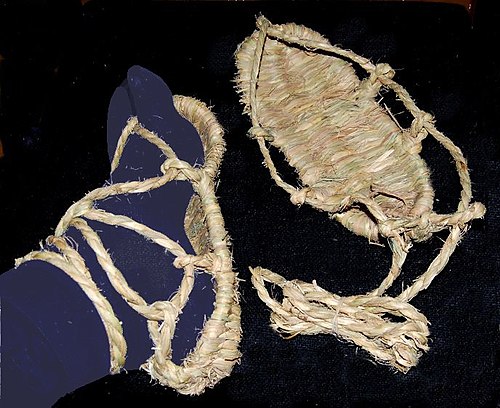
Waraji over indigo-blue tabi, the sock colour digitally altered for clarity

Similar four- and six-warp Chinese sandals, c. 1930 (other views)

Waraji were traditionally made in the home, as shown here (September 1914). Note twine warp, held between hands and toes, and loose-fiber weft, to his right.

Pictorial instructions on how to weave zōri (similar to waraji) in Hida Minzoku Mura Folk Village; most Japanese no longer regularly make waraji.