Old Kandahar
Videos
Old Kandahar is a historical section of the city of Kandahar in southern Afghanistan.

Ancient city of Old Kandahar (Alexandria Arachosia) (red) on the southwestern side of Kandahar

The failed Mughal Siege of Kandahar in 1649. Mughal, mid-17th century. Padshahnama.

An 1881 photo showing the ruined Old Kandahar citadel of Shah Hussain Hotak that was destroyed by the Afsharid forces of Nader Shah Afshar in 1738.

The citadel in 2018.
The Kandahar Bilingual Rock Inscription, also known as the Kandahar Edict of Ashoka and less commonly as the Chehel Zina Edict, is an inscription in the Greek and Aramaic languages that dates back to
Old Kandahar
…in Greek, dating to the 3rd-2nd century BC were discovered in or around the site of Old Kandahar, including the Kandahar Greek Edicts of Ashoka, the Kandahar Bilingual Rock Inscription also from the time of the Indian ruler Ashoka, the Kandahar Sophytos Inscription and an inscription made by a son of Aristonax…
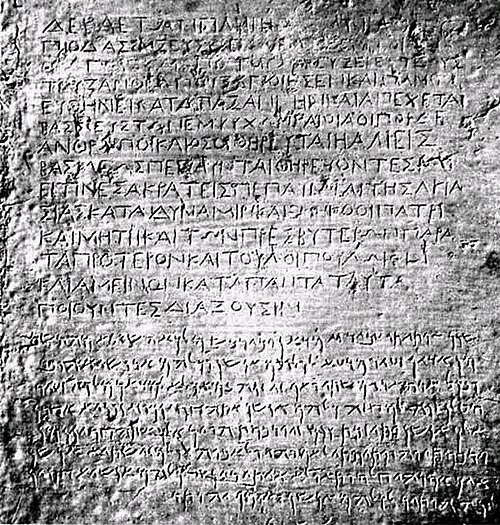
Bilingual inscription of Ashoka in Greek (top) and Aramaic (bottom) in Afghanistan

Chil Zena ("40 steps") complex, offering a commanding view of Kandahar, and on the mountainside of which the bilingual edict is carved. Chil Zena commands the entrance to the city of Kandahar when coming from the west.

The Kandahar Bilingual Rock Inscription was located at the edge of the Indian realm, near the border with the Greco-Bactrian kingdom and Ai-Khanoum.