Opabinia
Videos
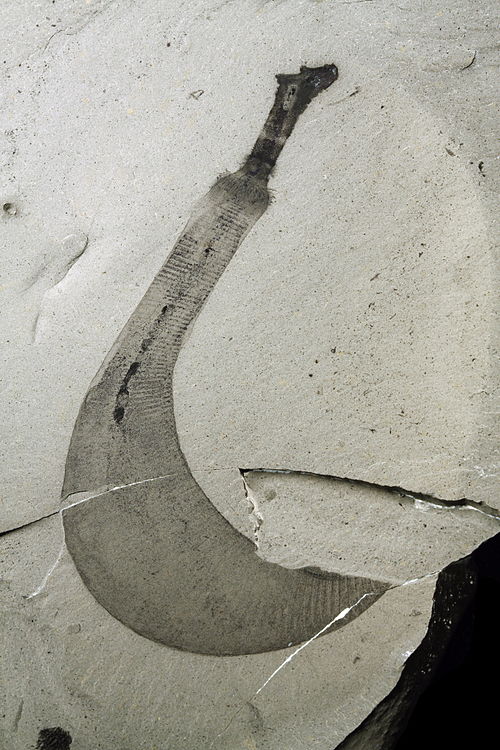
Opabinia regalis is an extinct, stem group marine arthropod found in the Middle Cambrian Burgess Shale Lagerstätte of British Columbia. Opabinia was a soft-bodied animal, measuring up to 7 cm in body


Comparison of Opabinia regalis from the Burgess Shale, and Utaurora comosa, from the Wheeler Formation, House Range, Utah, USA

Top left: retouched image of Opabinia (Walcott Cambrian Geology and Paleontology II by Charles Doolittle Walcott)
Burgess Shale
Videos
The Burgess Shale is a fossil-bearing deposit exposed in the Canadian Rockies of British Columbia, Canada. It is famous for the exceptional preservation of the soft parts of its fossils. At c.505 mill
Ottoia, a soft-bodied worm, abundant in the Burgess Shale. (From Smith et al. 2015)

Satellite image of the area.

Walcott Quarry of the Burgess Shale showing the Walcott Quarry Shale Member. The white parallel vertical streaks are remnants of drill holes made during excavations in the mid-1990s.

Restoration of the benthic environment of the site, showing Canadaspis perfecta gathering to mate and moult in the Walcott Quarry of the Burgess Shale (Phyllopod Bed, Layer -350), alongside other benthic animals like Wiwaxia, and the arthropod Marrella swimming above.