Operation Crossroads
Videos
Operation Crossroads was a pair of nuclear weapon tests conducted by the United States at Bikini Atoll in mid-1946. They were the first nuclear weapon tests since Trinity on July 16, 1945, and the fir

Prospective Operation Crossroads target ships and support ships at Pearl Harbor on February 27, 1946. Ships from front to rear: USS Crittenden, Catron, Bracken, Burleson, Gilliam, Fallon, unknown ship, Fillmore, Kochab, Luna, and an unidentified tanker and Liberty ship. On the right are LSM-203 and LSM-465. Farther in the background are a floating drydock and a merchant ship hulk.

View of the target fleet for test Able.

Nevada painted in high visibility orange for the atomic tests

The target fleet after test Able. The aircraft carrier Saratoga is right-center with Independence burning at left-center. The battleship Nagato is between them. The ship at left, next to the battleship Pennsylvania, is trying to wash down the radioactivity with water from the lagoon.
German cruiser Prinz Eugen
Videos
Prinz Eugen was an Admiral Hipper-class heavy cruiser, the third of a class of five vessels. She served with Nazi Germany's Kriegsmarine during World War II. The ship was laid down in April 1936, laun
Operation Crossroads
…transports, two oilers, one floating drydock, and three surrendered Axis ships, the Japanese cruiser Sakawa, the battleship Nagato, and the German cruiser Prinz Eugen. The ships carried sample amounts of fuel and ammunition, plus scientific instruments to measure air pressure, ship movement, and radiation. The live…
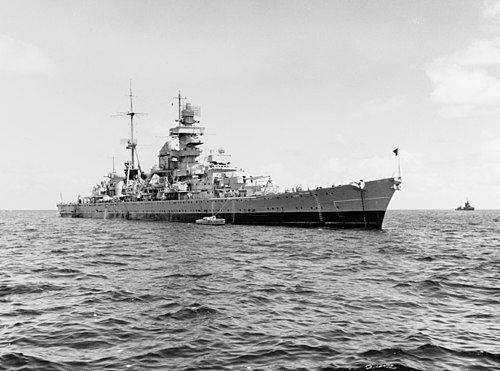
As USS Prinz Eugen, before the atomic bomb tests at Bikini Atoll

Recognition drawing of Prinz Eugen

Prinz Eugen's launch at Kiel, 22 August 1938

Painting of Bismarck (center) and Prinz Eugen (right background) engaging the British at the Battle of the Denmark Strait