The Orion molecular cloud complex is a star-forming region with stellar ages ranging up to 12 Myr. Two giant molecular clouds are a part of it, Orion A and Orion B. The stars currently forming within
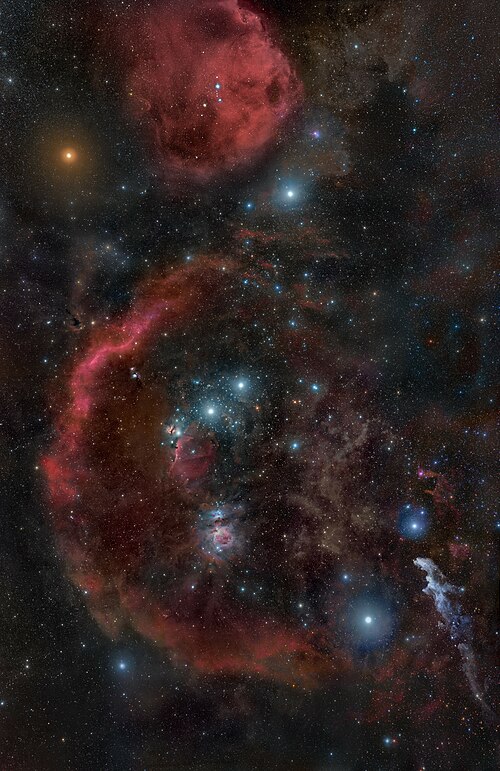
Part of the Orion molecular cloud complex, with the Great Nebula in Orion near the center, along with the Belt of Orion, and Barnard's Loop curling around the image

Young stars in Orion A and Orion B molecular clouds. The clouds were imaged by Herschel and the newborn stars were imaged by ALMA and the VLA.

Position of the Orion Molecular Clouds

HII regions (red) and molecular clouds (green to blue) in the Orion–Eridanus Superbubble seen by the Northern Sky Narrowband Survey. The reflection nebulae in the northwestern (upper right) part of the image belong to molecular clouds in Taurus.
Molecular cloud
Videos
A molecular cloud—sometimes called a stellar nursery if star formation is occurring within—is a type of interstellar cloud of which the density and size permit absorption nebulae, the formation of mol
Orion molecular cloud complex
…The Orion molecular cloud complex (or, simply, the Orion complex) is a star-forming region with stellar ages ranging up to 12 Myr. Two giant molecular clouds are a part of it, Orion A and Orion B. The stars currently forming within the complex are located within these clouds. A number of other somewhat older…

Astronomer Henk van de Hulst first theorized hydrogen could be traceable in interstellar space using radio signals.

Plaque commemorating the discovery of 21-cm radiation from the Milky Way

Left to right: Jan Oort, Hendrik C. van de Hulst, Pieter Oosterhoff. Jan Oort had a pivotal role in the research that lead to the discovery of molecular clouds.

Penzias and Wilson with the Holmdel horn antenna used to detect microwave emissions from the Big Bang