Our Lady of the Pillar
Videos
Our Lady of the Pillar is the name given to the Blessed Virgin Mary in the context of the traditional belief that Mary, while living in Jerusalem, supernaturally appeared to the Apostle James the Greater in AD 40 while he was preaching in what is now Spain. Those who adhere to this belief consider this appearance to be the only recorded instance of Mary exhibiting the mystical phenomenon of bilocation. Among Catholics, it is also considered the first Marian apparition, and unique because it happened while Mary was still living on Earth.

The image of Our Lady of the Pillar wearing her canonical crown

Apparition of the Virgin of the Pillar to Saint James and his Saragossan disciples by Francisco Goya, c. 1769
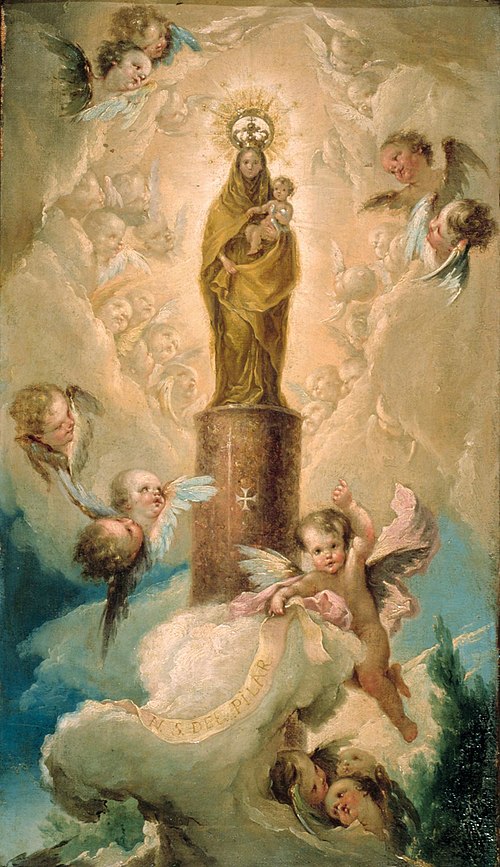
Our Lady of the Pillar by Ramón Bayeu, 1780

The work represents the Virgen del Pilar, patroness of Spain.
National Day of Spain
Videos
The National Day of Spain is a national holiday held annually on 12 October. It is also traditionally and commonly referred to as the Día de la Hispanidad, commemorating Spanish legacy worldwide, especially in Hispanic America.

Aerial parade by the Spanish Air Force Patrulla Águila (Eagle Patrol) drawing a Spanish flag with smoke at the Armed Forces Parade.

Cathedral-Basilica of Our Lady of the Pillar in Zaragoza

Spanish Constitution of 1978, the ninth fundamental law in the history of the Spanish constitutionalism since the Spanish Constitution of 1812

Parade for Hispanic Day (12 October) in Granada (Spain).