Overglaze decoration
Videos
Overglaze decoration, overglaze enamelling, or on-glaze decoration, is a method of decorating pottery, most often porcelain, where the coloured decoration is applied on top of the already fired and glazed surface, and then fixed in a second firing at a relatively low temperature, often in a muffle kiln. It is often described as producing "enamelled" decoration. The colours fuse on to the glaze, so the decoration becomes durable. This decorative firing is usually done at a lower temperature which allows for a more varied and vivid palette of colours, using pigments which will not colour correctly at the high temperature necessary to fire the porcelain body. Historically, a relatively narrow range of colours could be achieved with underglaze decoration, where the coloured pattern is applied before glazing, notably the cobalt blue of blue and white porcelain.


Nabeshima ware plate with floral design, Arita, Japan, late 17th century, Edo period.
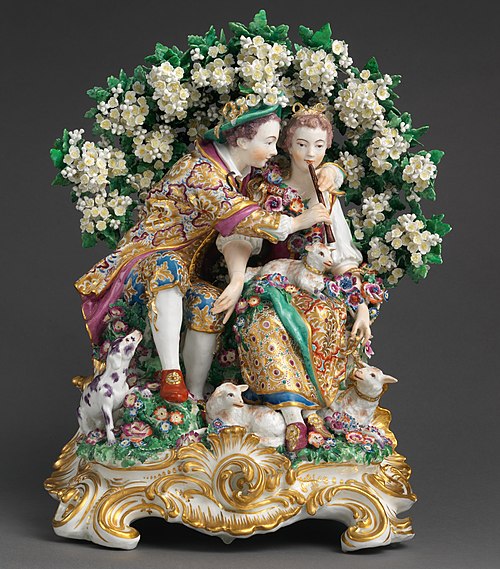
Chelsea porcelain factory, The Music Lesson, gold anchor, c. 1765, with bocage background. 15 3/8 × 12 1/4 × 8 3/4 inches, 22 lb. (39.1 × 31.1 × 22.2 cm, 10 kg). different version, different angle.
Mina'i ware
Videos
Mina'i ware is a type of Persian pottery, or Islamic pottery developed in Kashan, Iran, in the decades leading up to the Mongol invasion of Persia in 1219, after which production ceased. It has been described as "probably the most luxurious of all types of ceramic ware produced in the eastern Islamic lands during the medieval period". The ceramic body of white-ish fritware or stonepaste is fully decorated with detailed paintings using several colours, usually including figures.

Side view of the same bowl

The earliest Mina'i bowl dated and signed by Abu Zayd al-Kashani in 1187 CE, just a few years before the fall of the Seljuk Empire in 1194. Iran.

A Mina'i bowl, dated 1187 CE, a few years before the end of the Seljuk Empire in 1194. Scene of poetic recitation, with poetic verses inscribed on the rim: "If the beloved leaves me, what am I to do? If s/he does not see the wisdom of our union, what am I to do?". Kashan, Iran. Los Angeles County Museum of Art.