The overview effect is a cognitive shift reported by some astronauts while viewing the Earth from space. Researchers have characterized the effect as "a state of awe with self-transcendent qualities, precipitated by a particularly striking visual stimulus". The most prominent common aspects of personally experiencing the Earth from space are appreciation and perception of beauty, unexpected and even overwhelming emotion, and an increased sense of connection to other people and the Earth as a whole. The effect can cause changes in the observer’s self concept and value system, and can be transformative.
Earthrise (1968). Apollo 8 astronaut Bill Anders recalled, "When I looked up and saw the Earth coming up on this very stark, beat-up Moon horizon, I was immediately almost overcome with the thought, 'Here we came all this way to the Moon, and yet the most significant thing we’re seeing is our own home planet, the Earth.'"
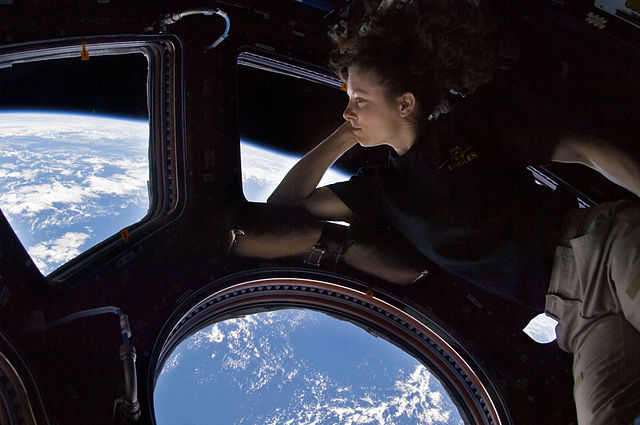
Astronaut Tracy Caldwell Dyson "Earth gazing" in the Cupola module of the International Space Station, a practice found to have positive psychological effects, one that is especially important in coping with the demands of spaceflight
The Blue Marble—Earth as seen by the crew of Apollo 17 in 1972. Early photos of Earth taken from space inspired a mild version of the overview effect in earthbound non-astronauts, and became prominent symbols of environmental concern.
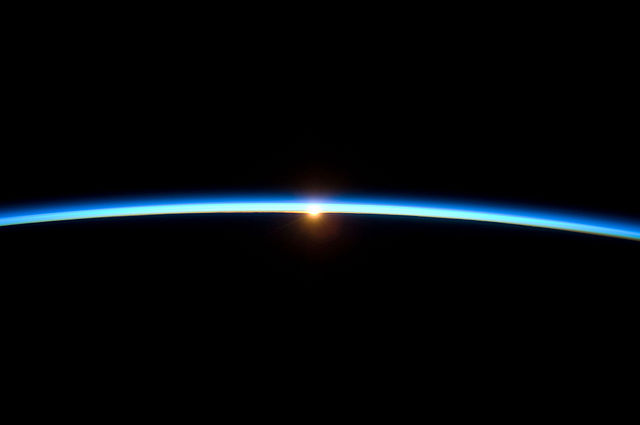
The Thin Blue Line photograph was taken from the International Space Station in 2009. Author Frank White's description of interviews with astronauts emphasized their perception of the "striking thinness of the atmosphere".
The Gaia hypothesis, also known as the Gaia theory, Gaia paradigm, or the Gaia principle, proposes that living organisms interact with their inorganic surroundings on Earth to form a synergistic and self-regulating, complex system that helps to maintain and perpetuate the conditions for life on the planet.
The study of planetary habitability is partly based upon extrapolation from knowledge of the Earth's conditions, as the Earth is the only planet currently known to harbour life (The Blue Marble, 1972 Apollo 17 photograph).
Levels of gases in the atmosphere in 420,000 years of ice core data from Vostok, Antarctica research station. Current period is at the left.
Earthrise taken from Apollo 8 by astronaut William Anders, December 24, 1968
James Lovelock, 2005